
Proof (AHL 1.15) is the topic where IB Mathematics Analysis & Approaches HL students lose the most marks per minute of work. The mathematics is rarely difficult — almost every proof in the syllabus reduces to a parity argument, a perfect-square inequality, or the irrationality of $\sqrt{N}$. What kills the marks is the language: writing "let" instead of "assume", forgetting to justify multiplication of an inequality by a positive quantity, or skipping the final conclusion sentence. Each of these costs a guaranteed R1, and there is no algebra hack to recover it.
This cheatsheet condenses every framework, template, trick and trap from AHL 1.15 into one revision page — direct proof, proof by contradiction, and counterexample. Scroll to the bottom for the printable PDF, the full Notes, the worked tutorials and the marked-up solutions in the gated student library.
§1 — Direct Proof AHL 1.15
The 4-step framework
- Name your integers. Write $n = 2k$, $n = 2k + 1$, $n = mk$, etc., with explicit $k \in \mathbb{Z}$.
- Substitute and expand. Do the algebra carefully — keep both sides tidy.
- Identify the structure. Factor out $m$, identify even/odd, spot the divisibility.
- State the conclusion. Explicitly say why the result follows. Never leave it implicit.
Parity and divisibility
Key representations table
| Type | Write as | Key property |
|---|---|---|
| Even integer | $n = 2k$, $k \in \mathbb{Z}$ | $n^2 = 4k^2 \equiv 0 \pmod 4$ |
| Odd integer | $n = 2k + 1$, $k \in \mathbb{Z}$ | $n^2 = 4k^2 + 4k + 1 \equiv 1 \pmod 4$ |
| Multiple of $m$ | $n = mk$, $k \in \mathbb{Z}$ | — |
| Rational number | $r = p/q$, $\gcd(p, q) = 1$, $q \neq 0$ | In lowest terms |
Algebraic identity proofs
Conclusion language
§2 — Proof by Contradiction AHL 1.15
The 5-step framework
- State the assumption. Write: "Assume for contradiction that [negation of claim]."
- Justify any manipulations. If multiplying an inequality, state the sign first.
- Derive the algebra. Rearrange, expand, substitute — towards a contradiction.
- Name the contradiction. Explicitly identify what is impossible (even = odd, square $< 0$, etc.).
- Conclude. "This is a contradiction. Therefore [original claim] is proved."
The assumption word — most important rule
Negation guide
| Original claim $P$ | What to assume ($\neg P$) |
|---|---|
| $\sqrt{N}$ is irrational | Assume $\sqrt{N} = p/q$ with $\gcd(p, q) = 1$ |
| $f(x) = 0$ has no integer roots | Assume $\exists\, \alpha \in \mathbb{Z}$ such that $f(\alpha) = 0$ |
| $p^2 - 8q - 11 \neq 0$ for $p, q \in \mathbb{Z}$ | Assume $p^2 - 8q - 11 = 0$ for some $p, q \in \mathbb{Z}$ |
| $f(x) \geq c$ on interval | Assume $f(x) < c$ for some $x$ in interval |
| $a$ and $b$ cannot both be odd | Assume $a$ and $b$ are both odd |
| There are infinitely many primes | Assume there are only $n$ primes: $p_1, \ldots, p_n$ |
| $a + b$ irrational ($a$ rational, $b$ irrational) | Assume $a + b$ is rational |
The three contradiction types (by IB frequency)
§3 — Irrationality Proof Template AHL 1.15
Proving $\sqrt{N}$ is irrational (where $N$ is prime):
- Assume $\sqrt{N}$ is rational: $\sqrt{N} = \dfrac{p}{q}$, $p, q \in \mathbb{Z}$, $q \neq 0$, $\gcd(p, q) = 1$.
- $\Rightarrow N q^2 = p^2 \Rightarrow N \mid p^2 \Rightarrow N \mid p$ (since $N$ is prime) $\Rightarrow p = Nk$.
- $\Rightarrow N q^2 = N^2 k^2 \Rightarrow q^2 = N k^2 \Rightarrow N \mid q^2 \Rightarrow N \mid q$.
- Contradiction: $N \mid p$ and $N \mid q$, but $\gcd(p, q) = 1$. $\therefore \sqrt{N}$ is irrational. $\blacksquare$
§4 — Inequality Proof Template AHL 1.15
Proving $f(x) \geq c$ by contradiction:
- Assume $f(x) < c$ for some valid $x$.
- Justify sign: state that the denominator/quantity you will multiply by is positive (earns R1).
- Rearrange: multiply both sides, collect terms, complete the square $\Rightarrow (\ldots)^2 < 0$.
- Contradiction: a squared real expression is always $\geq 0$. $\therefore f(x) \geq c$. $\blacksquare$
Example: Prove $\dfrac{1}{x(1 - x)} \geq 4$ for $0 < x < 1$.
Assume $\dfrac{1}{x(1 - x)} < 4$. Since $x(1 - x) > 0$: $1 < 4x(1 - x) \Rightarrow 4x^2 - 4x + 1 < 0 \Rightarrow (2x - 1)^2 < 0$. Contradiction.
§5 — Parity Argument Template AHL 1.15
Integer/parity contradiction pattern:
- Assume $f(p, q) = 0$ for some $p, q \in \mathbb{Z}$.
- Step 1: Determine parity of $p$ from the equation (check: if $p$ even $\Rightarrow$ LHS even, RHS odd $\Rightarrow$ impossible, so $p$ must be odd).
- Step 2: Write $p = 2k + 1$, substitute, expand.
- Step 3: Show one side is even and the other odd.
- Contradiction: An even number cannot equal an odd number. $\blacksquare$
Traps to avoid in contradiction proofs
§6 — Counterexample AHL 1.15
The 3-step framework
- State the value. Give the specific value(s): "Let $n = 4$" or "Let $a = 1$, $b = 1$".
- Compute both sides. Show the full calculation — never just assert the result.
- Explain why it fails. State clearly which property of the original claim is violated.
How to find a counterexample efficiently
§7 — Famous IB Counterexamples to Know AHL 1.15
| False claim | Counterexample | Why it fails |
|---|---|---|
| $n^2 + n + 41$ always prime | $n = 40$: $40^2 + 40 + 41 = 41^2$ | $41 \times 41$, not prime |
| $n^2 + 41n + 41$ always prime (IB) | $n = 41$: $41^2 + 41^2 + 41 = 41 \times 83$ | $41$ is a factor |
| $n^2 + n + 5$ always prime | $n = 4$: $16 + 4 + 5 = 25 = 5^2$ | Not prime |
| $2^n - 1$ always prime | $n = 4$: $2^4 - 1 = 15 = 3 \times 5$ | Not prime |
| $(m + n)^2 = m^2 + n^2$ | $m = 1, n = 1$: $4 \neq 2$ | Neglects $2mn$ term |
| Div by 6 and 10 $\Rightarrow$ div by 60 | $n = 30$ | $30 \div 60 = 0.5$ |
| $x^2 + y^2 = 10$ has no positive int sols | $x = 1, y = 3$: $1 + 9 = 10$ | Solution exists |
Prove or disprove questions
§8 — Decision Plan & Trigger Table AHL 1.15
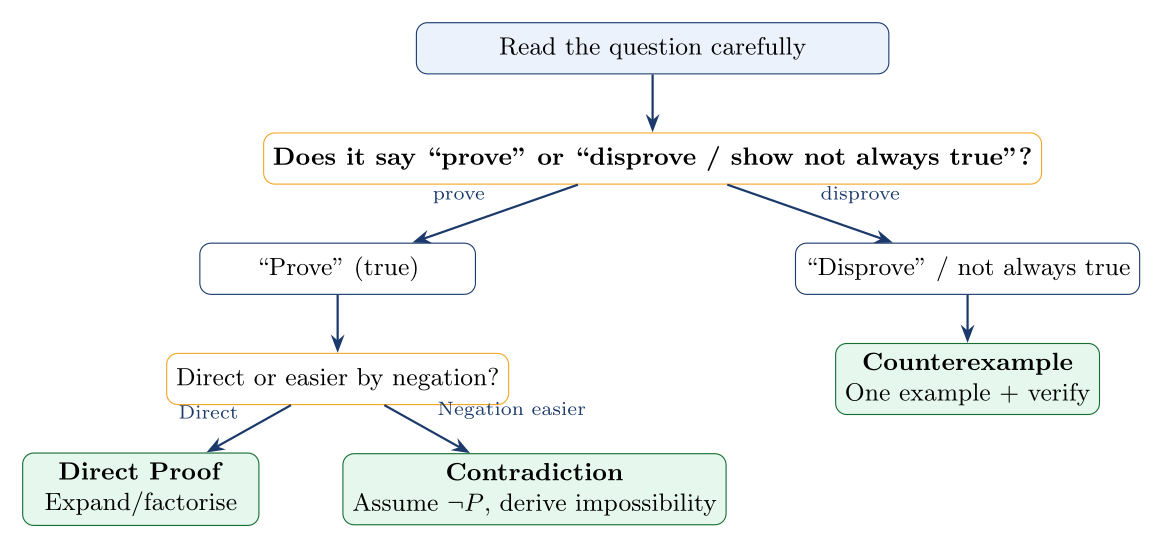
Decision flow:
- Read the question carefully.
- Does it say prove (true) or disprove / not always true?
- If prove: try direct first. If the negation creates a tangible constraint (parity, irrationality, inequality), use contradiction.
- If disprove: find a counterexample, verify, explain.
If you see… then reach for…
| You see in the question… | Technique to use |
|---|---|
| Equation with all-even coefficients + odd constant | Parity contradiction: LHS even, RHS odd |
| Prove $f(x) \geq c$ or $f(x) > c$ | Contradiction: assume $f < c$, rearrange to $(\ldots)^2 < 0$ |
| Prove $\sqrt{N}$ irrational ($N$ prime) | Contradiction + irrationality template |
| "$a$ and $b$ cannot both be…" | Contradiction: assume they ARE both that way |
| $a^2 + b^2$ divisible by 4 | Write $a = 2m + 1$, $b = 2n + 1$; sum $\equiv 2 \pmod 4$, contradiction |
| Prove $\sqrt{XY} \leq \tfrac{X + Y}{2}$ type | Contradiction: assume $>$, square both sides, get $(X - Y)^2 < 0$ |
| "Show the statement is not always true" | Counterexample: find $n$, verify it fails, explain |
| "$f(n)$ is not always prime" | Counterexample: find $n$ that makes $f(n)$ composite, show factorisation |
| "Prove or disprove" | Test small values first; pick the correct approach based on what you find |
§9 — Mark Scheme Codes & Final Checklist AHL 1.15
| Code | Name | What it means in proof questions |
|---|---|---|
| M1 | Method mark | Usually awarded for the correct assumption statement (contradiction) or the correct setup (direct) |
| A1 | Accuracy mark | Correct algebra, expansion, substitution |
| (A1) | Implied accuracy | Correct intermediate step; often awarded even if not explicitly shown |
| R1 | Reasoning mark | Logical conclusion: naming the contradiction, stating why result follows, identifying parity |
| AG | Answer given | Answer is printed in the question; you must show full working to earn all preceding marks |
5-second proof checklist before submitting
- Used "assume" or "suppose" (not "let" or "consider") in contradiction proofs.
- Named all integers with types: "where $k \in \mathbb{Z}$".
- Justified the sign when multiplying an inequality.
- Named the contradiction explicitly ("even = odd", "square $< 0$", etc.).
- Written a conclusion sentence restating the original claim.
- For counterexamples: stated the value AND computed AND explained why.
- Not assumed what you're trying to prove (no circular argument).
Worked Example — IB-Style Proof by Contradiction
Question (HL Paper 1 style — 7 marks)
Prove, by contradiction, that there are no integers $p$ and $q$ such that $p^2 - 8q = 11$.
Solution
- Assume for contradiction that there exist $p, q \in \mathbb{Z}$ such that $p^2 - 8q = 11$. (M1)
- Rearrange: $p^2 = 8q + 11$. (A1)
- Determine the parity of $p$. The RHS is $8q + 11$. Since $8q$ is even and $11$ is odd, $8q + 11$ is odd. So $p^2$ is odd, which forces $p$ to be odd. (R1)
- Write $p = 2k + 1$ for some $k \in \mathbb{Z}$. Then
$p^2 = (2k + 1)^2 = 4k^2 + 4k + 1 = 4k(k + 1) + 1$. (M1)(A1) - Note that $k(k + 1)$ is the product of two consecutive integers, so $k(k + 1)$ is even. Write $k(k + 1) = 2m$ for some $m \in \mathbb{Z}$. Then $p^2 = 8m + 1$. (R1)
- Substitute back: $8m + 1 = 8q + 11 \Rightarrow 8m - 8q = 10 \Rightarrow 8(m - q) = 10 \Rightarrow m - q = \tfrac{10}{8} = \tfrac{5}{4}$.
But $m - q \in \mathbb{Z}$, while $\tfrac{5}{4} \notin \mathbb{Z}$. Contradiction. Therefore there are no integers $p, q$ such that $p^2 - 8q = 11$. $\blacksquare$ (R1)
Examiner's note: The most common errors in this question are (i) starting with "Let $p, q \in \mathbb{Z}$…" — losing the assumption mark — and (ii) failing to spot that $p^2 \equiv 1 \pmod 8$ for odd $p$, which is the key step. The Photon Academy approach is to memorise the four squares modulo 8: $0, 1, 4$ — only those three residues occur, never 11 mod 8 = 3.
Common Student Questions
Why does writing "Let" instead of "Assume" lose marks in a proof by contradiction?
When proving an inequality by contradiction, why must I justify the sign before multiplying?
How do I prove that $\sqrt{N}$ is irrational when $N$ is prime?
Is one counterexample enough to disprove a "for all" claim?
What is the difference between "show that" and "prove"?
Get the printable PDF cheatsheet — free
The same cheatsheet on one A4 page — formulas, methods and traps. No sign-in needed.