
Polynomials are the foundation of nearly every algebra question in IB Mathematics Analysis & Approaches HL. The HL extension over SL is significant — beyond curve sketching and quadratic formulas, you also need the Conjugate Root Theorem, Vieta's formulas, double-root conditions, polynomial division, and the symmetric-function identities for transformed roots. Together these account for two or three multi-mark questions on every Paper 1 and a regular feature in Section B.
What makes polynomials tricky is the trap density: a single sign error in Vieta's, a forgotten conjugate, or a constant remainder where a linear remainder was needed will collapse the rest of a six-mark question. This cheatsheet condenses every formula, method, and trap from SL 2.5–2.7 and AHL 2.12–2.16 into one page you can revise from. For the printable PDF, full notes, tutorial booklet, and marked-up solutions, scroll to the bottom.
§1 — Polynomial Structure AHL 2.12
Definition & notation
$P(x) = a_n x^n + a_{n-1}x^{n-1} + \cdots + a_1 x + a_0, \quad a_n \neq 0$
- Degree $= n$ (highest power); leading coefficient $= a_n$
- Constant term $= a_0$; monic iff $a_n = 1$
- Degree 1: linear; 2: quadratic; 3: cubic; 4: quartic
End behaviour (arms)
| Degree | $a_n > 0$ | $a_n < 0$ |
|---|---|---|
| Odd | Left down, right up | Left up, right down |
| Even | Both up | Both down |
Root multiplicity — graph behaviour at $x = a$
| Multiplicity | Graph at root | Factor |
|---|---|---|
| 1 (simple) | Crosses the axis | $(x-a)$ |
| 2 (double) | Touches and bounces — axis is tangent | $(x-a)^2$ |
| 3 (triple) | Crosses with an inflection (S-shape) | $(x-a)^3$ |
| $2k$ (even) | Always bounces — never crosses | $(x-a)^{2k}$ |
| $2k+1$ (odd) | Always crosses (flatter for higher mult.) | $(x-a)^{2k+1}$ |
§2 — Quartic Graph Cases AHL 2.12

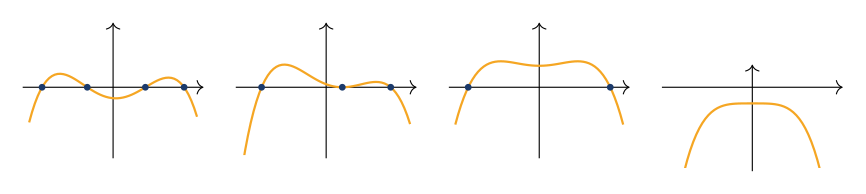
$a_4 > 0$ — arms both up
The five canonical shapes are: 4 distinct real roots; one double root + 2 simple roots; two double roots; 2 real + 2 complex roots; no real roots (graph stays above the $x$-axis).
$a_4 < 0$ — arms both down
The four canonical shapes (mirror of the $a_4 > 0$ cases): 4 distinct real roots; one double root + 2 simple; 2 real + 2 complex; no real roots (graph stays below the $x$-axis).
§3 — Complex Roots in Polynomials AHL 1.14 / 2.12
Conjugate Root Theorem
If $P(x)$ has real coefficients and $\alpha = a + bi$ ($b \neq 0$) is a root, then $\bar\alpha = a - bi$ is also a root.
Real quadratic factor: $(x - \alpha)(x - \bar\alpha) = (x - a)^2 + b^2$.
Consequence: a real polynomial of odd degree always has at least one real root.
Quadratic discriminant
- $\Delta > 0$: two distinct real roots
- $\Delta = 0$: one repeated real root
- $\Delta < 0$: two complex conjugate roots: $x = \dfrac{-b \pm i\sqrt{4ac - b^2}}{2a}$
Using the Conjugate Root Theorem — 4-step method
Given a complex root $\alpha = a + bi$ of a real polynomial $P(x)$ of degree $n$:
- Write $\bar\alpha = a - bi$ immediately (second root).
- Form the real quadratic factor: $(x - a)^2 + b^2$.
- Divide $P(x)$ by this quadratic (long division or coefficient comparison).
- Factorise the remaining polynomial to find all other roots.
§4 — Remainder & Factor Theorems AHL 2.12
Remainder Theorem
Dividing by $(ax - b)$: substitute $x = b/a$. Key use: find an unknown coefficient given a remainder.
Factor Theorem
$(x - a)$ is a factor of $P(x) \iff P(a) = 0$. More generally, $(ax - b)$ is a factor $\iff P\!\left(\dfrac{b}{a}\right) = 0$.
Rational root candidates: $\dfrac{p}{q}$ where $p \mid a_0$ and $q \mid a_n$.
Double-root condition — when $(x - a)^2$ divides $P(x)$
$(x - a)^2$ divides $P(x)$ exactly $\iff$ both of these hold:
$$P(a) = 0 \qquad \text{AND} \qquad P'(a) = 0$$
This gives two simultaneous equations for two unknowns. Differentiate $P(x)$ directly — do not attempt long division first.
§5 — Polynomial Division AHL 2.12
Division algorithm
| Divisor | Remainder form | Method |
|---|---|---|
| Linear $(x - a)$ | Constant $R$ | Synthetic or long division |
| Quadratic | Linear $mx + c$ | Long division only |
| Cubic | Quadratic $ax^2 + bx + c$ | Long division only |
Critical: always insert $0x^k$ for missing powers before dividing.
Synthetic division (linear divisors only)
To divide by $(x - c)$: write the coefficients in a row, bring down $a_n$, multiply by $c$, add to the next coefficient, repeat. The last entry equals the remainder $R = P(c)$; the remaining entries are the quotient coefficients.
Quadratic divisor — remainder shortcut
Divide by $(x - a)(x - b)$; let $R = mx + c$. Then $P(a) = ma + c$ and $P(b) = mb + c$ — solve simultaneously.
Divide by $(x - a)^2$; let $R = mx + c$. Then $P(a) = ma + c$ and $P'(a) = m$.
§6 — Factoring Higher-Degree Polynomials AHL 2.12
Method selector
| Situation | Best method |
|---|---|
| No information given | Factor Theorem trial: $\pm p/q$ where $p \mid a_0$, $q \mid a_n$ |
| A linear factor is given | Divide immediately: synthetic division |
| A quadratic factor is given | Long division by the quadratic |
| Form of factorisation known | Coefficient comparison — faster than dividing |
| Complex root given | Write conjugate; form $(x - a)^2 + b^2$; divide |
| "Divisible by $(x - a)^2$" | $P(a) = 0$ and $P'(a) = 0$ simultaneously |
| Cubic — after one root found | Reduce to quadratic; then use formula or factorisation |
Over $\mathbb{R}$ vs over $\mathbb{C}$
Over $\mathbb{R}$: write as a product of linear and irreducible quadratic factors. $(x^2 + bx + c)$ is irreducible when $\Delta < 0$.
Over $\mathbb{C}$: every factor is linear. A degree $n$ polynomial $=$ exactly $n$ linear factors. Irreducible quadratics split over $\mathbb{C}$ into conjugate linear factors.
Grouping shortcut
Look for a common-factor structure: $ax^3 + bx^2 + ax + b = x^2(ax + b) + (ax + b) = (ax + b)(x^2 + 1)$. This works when the middle terms share a ratio with the outer terms — saves time on Paper 1 cubics.
§7 — Vieta's Formulas (Sum & Product of Roots) AHL 2.12
General Vieta's (formula booklet)
For $a_n x^n + \cdots + a_0 = 0$ with roots $r_1, \ldots, r_n$:
Quadratic and cubic forms
Quadratic $ax^2 + bx + c = 0$ with roots $\alpha, \beta$: $\alpha + \beta = -b/a$, $\alpha\beta = c/a$.
Cubic $ax^3 + bx^2 + cx + d = 0$ with roots $\alpha, \beta, \gamma$:
- $\alpha + \beta + \gamma = -b/a$
- $\alpha\beta + \beta\gamma + \gamma\alpha = c/a$
- $\alpha\beta\gamma = -d/a$
Symmetric function identities — derive without solving
Let $S = \alpha + \beta$ and $P = \alpha\beta$. Then:
- $\alpha^2 + \beta^2 = S^2 - 2P$
- $(\alpha - \beta)^2 = S^2 - 4P$
- $\alpha^3 + \beta^3 = S^3 - 3SP$
- $\alpha^2\beta + \alpha\beta^2 = SP$
- $\dfrac{1}{\alpha} + \dfrac{1}{\beta} = \dfrac{S}{P}, \quad \dfrac{1}{\alpha}\cdot\dfrac{1}{\beta} = \dfrac{1}{P}$
§8 — Transformations & Root Analysis SL 2.11 / AHL 2.12
Effect of transformations on roots
| Transformation | New roots | Vieta impact |
|---|---|---|
| $g(x) = f(x - k)$ | $\alpha_i + k$ | New sum $=$ old sum $+ nk$ |
| $g(x) = f(x + k)$ | $\alpha_i - k$ | New sum $=$ old sum $- nk$ |
| $g(x) = f(kx)$, $k > 0$ | $\alpha_i / k$ | New sum $=$ old sum$/k$; new product $=$ old$/k^n$ |
| $g(x) = c\,f(x)$ | $\alpha_i$ unchanged | Only leading coeff changes |
| $g(x) = f(ax + b)$ | $(\alpha_i - b)/a$ | New sum $= (\text{old sum} - nb)/a$; new product $=$ old$/a^n$ |
| $g(x) = f(x) + c$ | Must re-solve $f(x) = -c$ | No shortcut |
Master substitution trick
To find the roots of $g(x) = f(ax + b)$: set $ax + b = \alpha_i$ for each original root $\alpha_i$, so $x = \dfrac{\alpha_i - b}{a}$. Each original root $\to$ one new root. No expansion needed.
Leading coefficient warning
If $f(x) = a_n x^n + \cdots$ and $g(x) = f(kx)$, then the leading coefficient of $g$ is $a_n \cdot k^n$, not $a_n$. This affects all Vieta calculations for $g(x)$. Always recompute $a_n$ for the transformed polynomial.
§9 — Special Root Structures AHL 2.12
Roots in arithmetic progression
Let the roots of a cubic be $a - d, a, a + d$. Then sum $= 3a = -b/a_3$, so $a = -\dfrac{b}{3a_3}$ — the middle root is always $-b/(3a_3)$, a root you get for free. Product $= a(a^2 - d^2) = -d_{\text{coeff}}/a_3$; use this to find $d$, then check the discriminant of the remaining quadratic for real/complex roots.
Roots in geometric progression
Let the roots of a cubic be $a/r, a, ar$. Then product $= a^3 = -d/a_3$, so the middle root is $\sqrt[3]{-d/a_3}$. Sum $= a(1/r + 1 + r) = -b/a_3$.
Other special structures
| Structure | What to write |
|---|---|
| One root is $k$ times another: $\beta = k\alpha$ | Vieta sum: $\alpha(1 + k) = -b/a$; product: $k\alpha^2 = c/a$. Divide. |
| Roots sum to zero | Coefficient of $x^{n-1}$ is zero: $a_{n-1} = 0$ |
| Roots are reciprocals | $\alpha \cdot (1/\alpha) = 1$, so product $= 1$, so $a_0 = (-1)^n a_n$ |
| One root is negative of another: $\beta = -\alpha$ | Product of that pair $= -\alpha^2 < 0$; use Vieta sign |
§10 — Exam Attack Plan All sections
When you see this in the question — reach for that:
| Question trigger | Reach for |
|---|---|
| "Remainder when $P(x) \div (x - a)$" | Compute $P(a)$ directly — no long division |
| "$(x - a)$ is a factor" | Write $P(a) = 0$ and solve |
| "Find all roots of cubic" | Factor Theorem trial $\to$ divide out $\to$ quadratic formula |
| "Exactly divisible by $(x - a)^2$" | $P(a) = 0$ AND $P'(a) = 0$ — two equations |
| "$P(x) \div (x - a)(x - b)$, find remainder" | Let $R = mx + c$; use $P(a)$ and $P(b)$ |
| "Complex root $a + bi$ given" | Write conjugate; form $(x - a)^2 + b^2$; divide |
| "Sum / product of roots" | Vieta's formulas — never solve for individual roots |
| "New equation with roots $f(\alpha), f(\beta)$" | Find new sum and product using symmetric identities |
| "Roots in AP" | Let $\{a - d, a, a + d\}$; sum gives $a$ immediately |
| "Roots in GP" | Let $\{a/r, a, ar\}$; product gives $a$ immediately |
| "$g(x) = f(ax + b)$, find roots" | Each new root $= (\alpha_i - b)/a$ |
| "Both roots positive" | Require $\alpha\beta > 0$ AND $\alpha + \beta > 0$ |
| "Show $P(x)$ has no real roots" | Prove discriminant $< 0$, or prove $P(x) > 0$ always |
| "Factorise over $\mathbb{R}$" | Keep irreducible quadratics; don't split into complex |
| "Factorise over $\mathbb{C}$" | Split everything into linear factors |
Worked Example — IB-Style Polynomial with a Complex Root
Question (HL Paper 1 style — 8 marks)
The polynomial $P(x) = 2x^4 - 3x^3 + ax^2 + bx + 10$ has $1 - 2i$ as a root, where $a, b \in \mathbb{R}$. Find the values of $a$ and $b$, and hence find all four roots of $P(x)$.
Solution
- Since $P$ has real coefficients and $1 - 2i$ is a root, by the Conjugate Root Theorem $1 + 2i$ is also a root. (R1)
- Form the real quadratic factor: $(x - 1)^2 + 2^2 = x^2 - 2x + 5$. (M1)(A1)
- Divide: $P(x) = (x^2 - 2x + 5)(2x^2 + cx + d)$ for some $c, d \in \mathbb{R}$. Expand and compare coefficients.
$x^3$ coeff: $-4 + c = -3 \Rightarrow c = 1$.
Constant: $5d = 10 \Rightarrow d = 2$. (M1)(A1) - Use the remaining coefficient comparisons to read off $a$ and $b$.
$x^2$ coeff: $10 - 2c + d = a$, so $a = 10 - 2 + 2 = 10$.
$x$ coeff: $5c - 2d = b$, so $b = 5 - 4 = 1$. (A1) - Solve $2x^2 + x + 2 = 0$: $\Delta = 1 - 16 = -15 < 0$, so $x = \dfrac{-1 \pm i\sqrt{15}}{4}$. (M1)
- The four roots are $1 + 2i,\; 1 - 2i,\; \dfrac{-1 + i\sqrt{15}}{4},\; \dfrac{-1 - i\sqrt{15}}{4}$. (A1)
Examiner's note: The two most common errors here are (a) writing the conjugate factor as $(x - 1)^2 - 4$ (wrong sign on $b^2$) and (b) forgetting that $P$ is degree 4, so there must be exactly four roots. If you only find two, you have stopped halfway and lost the final 3 marks.
Common Student Questions
Why is the sum of roots $-b/a$ and not $+b/a$?
What's the difference between $(x - a)^2$ being a factor and just $(x - a)$?
When the IB gives me one complex root, what should I write first?
How do I factorise a polynomial when no rational root works?
What's the fastest way to find the roots of $g(x) = f(ax + b)$?
Get the printable PDF cheatsheet — free
The same cheatsheet on one A4 page — formulas, methods and traps. No sign-in needed.