




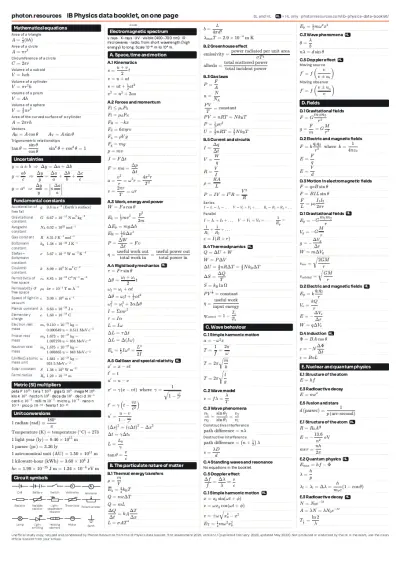
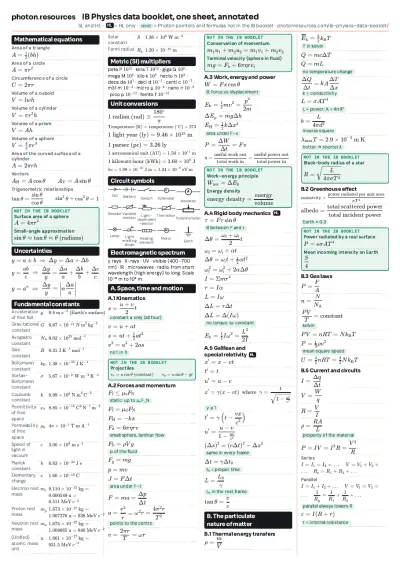
Photon Academy · IB Physics data booklet, annotated · ibtuition.sg/ib-physics-data-booklet/
Mathematical equations
Photon noteUsed for wires: the volume of a wire of length L is its cross-section times L.
Photon noteNeeded for Stokes' drag and buoyancy questions on spheres.
Photon noteCheck where θ is measured from. If the angle is given to the vertical, cos and sin swap.
Not in the IB booklet · learn or derive these
Used with the Stefan–Boltzmann law for stars and in the inverse-square law b = L/4πd².
Behind s = λD/d and θ = λ/b. Valid for small angles only.
Uncertainties
Photon noteAdding or subtracting: add the absolute uncertainties.
Photon noteMultiplying or dividing: add the fractional (or percentage) uncertainties.
Photon noteA power multiplies the fractional uncertainty. A square root halves it (n = ½).
Not in the IB booklet · learn or derive these
Round the final uncertainty to one significant figure, then round the value to match.
Fundamental constants
| Quantity | Symbol | Approximate value |
|---|---|---|
| Acceleration of free fall | g | 9.8\ \text{m s}^{-2}\ \text{(Earth's surface)} |
| Gravitational constant | G | 6.67\times10^{-11}\ \text{N m}^2\,\text{kg}^{-2} |
| Avogadro constant | N_\text{A} | 6.02\times10^{23}\ \text{mol}^{-1} |
| Gas constant | R | 8.31\ \text{J K}^{-1}\,\text{mol}^{-1} |
| Boltzmann constant | k_\text{B} | 1.38\times10^{-23}\ \text{J K}^{-1} Photon noteR = N_\text{A} k_\text{B}, so you can switch between per-mole and per-particle forms. |
| Stefan–Boltzmann constant | \sigma | 5.67\times10^{-8}\ \text{W m}^{-2}\,\text{K}^{-4} |
| Coulomb constant | k | 8.99\times10^{9}\ \text{N m}^2\,\text{C}^{-2} Photon noteDo not confuse with k_\text{B}, the spring constant k or thermal conductivity k. |
| Permittivity of free space | \varepsilon_0 | 8.85\times10^{-12}\ \text{C}^2\,\text{N}^{-1}\,\text{m}^{-2} |
| Permeability of free space | \mu_0 | 4\pi\times10^{-7}\ \text{T m A}^{-1} |
| Speed of light in vacuum | c | 3.00\times10^{8}\ \text{m s}^{-1} |
| Planck constant | h | 6.63\times10^{-34}\ \text{J s} |
| Elementary charge | e | 1.60\times10^{-19}\ \text{C} Photon noteAlso the conversion 1 eV = 1.60 × 10⁻¹⁹ J. |
| Electron rest mass | m_\text{e} | 9.110\times10^{-31}\ \text{kg}=0.000549\ \text{u}=0.511\ \text{MeV}\,c^{-2} |
| Proton rest mass | m_\text{p} | 1.673\times10^{-27}\ \text{kg}=1.007276\ \text{u}=938\ \text{MeV}\,c^{-2} |
| Neutron rest mass | m_\text{n} | 1.675\times10^{-27}\ \text{kg}=1.008665\ \text{u}=940\ \text{MeV}\,c^{-2} |
| (Unified) atomic mass unit | \text{u} | 1.661\times10^{-27}\ \text{kg}=931.5\ \text{MeV}\,c^{-2} Photon noteMass defect in u × 931.5 gives binding energy in MeV directly. |
| Solar constant | S | 1.36\times10^{3}\ \text{W m}^{-2} |
| Fermi radius | R_0 | 1.20\times10^{-15}\ \text{m} Photon noteUsed in R=R_0A^{1/3} (HL). |
Metric (SI) multipliers
| Prefix | Abbreviation | Value |
|---|---|---|
| peta | P | 10^{15} |
| tera | T | 10^{12} |
| giga | G | 10^{9} |
| mega | M | 10^{6} |
| kilo | k | 10^{3} |
| hecto | h | 10^{2} |
| deca | da | 10^{1} |
| deci | d | 10^{-1} |
| centi | c | 10^{-2} |
| milli | m | 10^{-3} |
| micro | μ | 10^{-6} |
| nano | n | 10^{-9} |
| pico | p | 10^{-12} |
| femto | f | 10^{-15} |
Unit conversions
Photon noteCalculator in radians for SHM, ω and θ = λ/b.
Photon noteGas laws, Wien's law and Stefan–Boltzmann always need kelvin.
Photon noteShortcut for photons: E (eV) = 1.24 × 10⁻⁶ / λ (m).
Electrical circuit symbols
Electromagnetic spectrum
← higher energy, shorter wavelengthlonger wavelength →
Visible light: violet 400 nm to red 700 nm (VIBGYOR).
Photon noteThe IB booklet shows this on a wavelength scale from 10⁻¹⁶ m to 10⁸ m. Band edges are approximate: the bands overlap.
A. Space, time and motion
Standard level and higher level
A.1 Kinematics
Photon noteAverage velocity × time. Uniform acceleration only, like all four of these.
Photon noteNo time in it: use it when t is neither given nor asked for.
Not in the IB booklet · learn or derive these
Split into horizontal and vertical. Only the vertical motion accelerates. Air resistance ignored.
A.2 Forces and momentum
Photon noteStatic friction rises to match the push, up to \mu_\text{s} F_\text{N}. At that limit the object starts to slide.
Photon noteDynamic friction once it slides.
Photon noteHooke's law. The minus sign shows the force opposes the extension.
Photon noteStokes' law: small sphere, slow, smooth (laminar) flow. η is viscosity.
Photon noteBuoyancy. ρ is the fluid's density and V the volume displaced.
Photon noteImpulse = change in momentum = area under the F–t graph.
Photon noteUse Δp/Δt when the mass changes (rockets, jets of water).
Photon noteCentripetal acceleration points to the centre. It is not a new force: find which force provides it.
Not in the IB booklet · learn or derive these
Holds whenever no external force acts. Kinetic energy is conserved only in elastic collisions.
Weight balances buoyancy plus drag.
A.3 Work, energy and power
Photon noteθ is the angle between force and displacement.
Photon noteOnly near the Earth's surface, where g is constant.
Photon noteElastic energy = area under the F–x graph.
Not in the IB booklet · learn or derive these
Often faster than forces and kinematics.
Specific energy is energy per unit mass. Watch which one is asked.
Additional higher level
A.4 Rigid body mechanics HL
Photon noteThe four rotational equations mirror A.1: s\to\theta, u\to\omega_\text{i}, v\to\omega_\text{f}, a\to\alpha.
Photon noteMoments of inertia of standard shapes are given in the question when needed.
Photon noteWith no external torque, Iω stays constant (a skater pulling in her arms spins faster).
A.5 Galilean and special relativity HL
Photon noteGalilean transformations: everyday speeds.
Photon noteLorentz transformations. γ is always ≥ 1.
Photon noteThe spacetime interval is the same in every frame.
Photon noteΔt₀ is proper time: measured by the clock that is present at both events.
Photon noteL₀ is proper length: measured in the object's own rest frame.
Photon noteAngle of the x′ and ct′ axes on a spacetime diagram.
B. The particulate nature of matter
Standard level and higher level
B.1 Thermal energy transfers
Photon noteAverage kinetic energy of one particle of an ideal gas. T in kelvin.
Photon notec is specific heat capacity.
Photon noteDuring a change of state the temperature does not change.
Photon noteConduction. Here k is thermal conductivity, not the Coulomb constant.
Photon noteHere L is luminosity (power), not latent heat. A for a star is 4πR².
Photon noteApparent brightness falls with the square of distance.
Photon noteWien's law. Hotter objects peak at shorter wavelength.
Not in the IB booklet · learn or derive these
Combine L = σAT⁴ with A = 4πR².
B.2 Greenhouse effect
Photon note1 for a perfect black body.
Photon noteEarth's average albedo is about 0.3.
Not in the IB booklet · learn or derive these
Emissivity e scales the black-body value.
The solar constant spread over the whole sphere (πR² facing the Sun, 4πR² in total).
B.3 Gas laws
Photon noteFixed amount of gas. T in kelvin.
Photon noteKinetic theory. Here v² means the mean of the squared speeds.
Photon noteInternal energy of an ideal monatomic gas: kinetic only.
B.5 Current and circuits
Photon noteDefines resistance. Ohm's law is the special case where R stays constant.
Photon noteResistivity: a property of the material, not of the wire.
Photon noteAdding a resistor in parallel always lowers the total resistance.
Photon noter is the internal resistance of the cell.
Not in the IB booklet · learn or derive these
The 'lost volts' Ir grow as the current rises.
With an LDR or thermistor this makes light or temperature sensors.
Additional higher level
B.4 Thermodynamics HL
Photon noteW is work done BY the gas. Sign conventions are the usual source of lost marks.
Photon noteConstant pressure only. Otherwise use the area under the P–V graph.
Photon noteΩ is the number of microstates.
Photon noteAdiabatic change of an ideal monatomic gas (Q = 0).
Photon noteThe maximum possible efficiency. Temperatures in kelvin.
C. Wave behaviour
Standard level and higher level
C.1 Simple harmonic motion
Photon noteThe definition of SHM: acceleration proportional to displacement and opposite in direction.
Photon noteMass on a spring.
Photon noteSimple pendulum, small angles. Mass does not affect T.
Not in the IB booklet · learn or derive these
Rearranged from the booklet line above. Used constantly.
C.2 Wave model
Photon noteFrequency is set by the source. When a wave changes medium, v and λ change, f does not.
Not in the IB booklet · learn or derive these
Double the amplitude, four times the intensity.
For a point source radiating equally in all directions.
C.3 Wave phenomena
Photon noteSnell's law. Note the order: n₁ on top pairs with sin θ₂ on top. Angles from the normal.
Photon noteDouble slit: s is fringe spacing, D slit-to-screen distance, d slit separation.
Not in the IB booklet · learn or derive these
Going from the denser medium (n₁) to the less dense one (n₂). Beyond c: total internal reflection.
C.4 Standing waves and resonance
The IB booklet gives no equations for this topic.
Not in the IB booklet · learn or derive these
C.4 has no equations in the booklet. Draw the pattern first: node–antinode spacing is λ/4.
Only odd harmonics.
C.5 Doppler effect
Photon noteLight, or any wave where v ≪ c. Redshift means moving away.
Additional higher level
C.1 Simple harmonic motion HL
Photon noteφ is the phase. Use cos if the motion starts at maximum displacement.
Photon noteMaximum speed ωx₀ at the centre (x = 0).
Photon noteTotal energy is constant.
Not in the IB booklet · learn or derive these
E_\text{T}-E_\text{p}.
C.3 Wave phenomena HL
Photon noteSingle slit: angle to the first minimum, in radians. b is the slit width.
Photon noteDiffraction grating. d = 1 / (lines per metre).
C.5 Doppler effect HL
Photon noteSource approaching: use minus (frequency rises).
Photon noteObserver approaching: use plus.
D. Fields
Standard level and higher level
D.1 Gravitational fields
Photon noter is centre to centre, not surface to surface.
Not in the IB booklet · learn or derive these
From G Mm/r² = m 4π²r/T². T² ∝ r³.
D.2 Electric and magnetic fields
Photon noteUniform field between parallel plates only.
D.3 Motion in electromagnetic fields
Photon noteUse the right-hand rule. Flip the direction for negative charges.
Photon noteParallel wires: same direction attract, opposite repel.
Not in the IB booklet · learn or derive these
From qvB = mv²/r. The magnetic force does no work, so the speed stays the same.
When the electric and magnetic forces balance.
Additional higher level
D.1 Gravitational fields HL
Photon noteZero at infinity, so it is always negative.
Photon noteField strength = minus the gradient of the potential.
Photon noteOrbital speed does not depend on the satellite's mass.
Not in the IB booklet · learn or derive these
E_\text{k}=\frac{GMm}{2r} and E_\text{p}=-\frac{GMm}{r}.
D.2 Electric and magnetic fields HL
Photon notePotential is a scalar: add potentials from several charges with their signs.
D.4 Induction HL
Photon noteθ is between B and the normal to the area.
Photon noteFaraday's law. The minus sign is Lenz's law.
Photon noteA rod moving through a field.
Not in the IB booklet · learn or derive these
Unit: Wb turns.
E. Nuclear and quantum physics
Standard level and higher level
E.1 Structure of the atom
Photon notePhoton energy. For a transition, hf equals the difference between the two levels.
Not in the IB booklet · learn or derive these
Use hc = 1.24 × 10⁻⁶ eV m for answers in eV.
E.3 Radioactive decay
Not in the IB booklet · learn or derive these
Δm = (mass of separate nucleons) − (mass of nucleus). In u, multiply by 931.5 for MeV.
n is the number of half-lives. SL questions use whole numbers of half-lives.
E.5 Fusion and stars
Photon noteStellar parallax. Works for nearby stars only.
Additional higher level
E.1 Structure of the atom HL
Photon noteNuclear density comes out the same for all nuclei.
Photon noteHydrogen only.
Photon noteBohr model: angular momentum is quantised.
E.2 Quantum physics HL
Photon notePhotoelectric effect. Φ is the work function. Intensity changes the number of electrons, not E_\text{max}.
Photon notede Broglie wavelength.
Photon noteCompton scattering.
Not in the IB booklet · learn or derive these
Below f₀ no electrons are emitted, however bright the light.
E.3 Radioactive decay HL
Photon noteHere λ is the decay constant, not wavelength.
Source: IB Physics data booklet, first assessment 2025, version 1.1 (published February 2023, updated May 2023), retyped by Photon Academy. This is an unofficial study companion, not produced or endorsed by the International Baccalaureate. In the exam you use the clean official booklet your school provides. All notes and extra formulas are ours.