Free worked solutions · 2026 Edition

IB Physics TI: Tools and inquiry worked solutions

Worked solutions to every practice question in TI: Tools and inquiry of Photon Physics: Study Guide for the IB Diploma (SL & HL). Try each question, then compare your working with the full solution.

  • SL & HL
  • 28 questions
  • Full worked solutions
  • Free, no sign-up

Basic practice

Question B1

Type 1 · Unit in base units / P1A[1 mark]
The power radiated by a hot surface is P=\sigma AT^4 (data booklet), where A is the area and T the absolute temperature. What is the unit of \sigma in SI base units?
A. \mathrm{kg\,s^{-3}\,K^{-4}}   B. \mathrm{kg\,m^2\,s^{-3}\,K^{-4}}   C. \mathrm{kg\,s^{-2}\,K^{-4}}   D. \mathrm{kg\,m^{-2}\,s^{-3}\,K^{-4}}
Show solutionHide solution
\sigma=P/(AT^4). A watt is \mathrm{J\,s^{-1}}=\mathrm{kg\,m^2\,s^{-3}}; dividing by \mathrm{m^2} and by \mathrm{K^4} leaves \mathrm{kg\,s^{-3}\,K^{-4}}. B forgets to divide by the area, C uses the joule instead of the watt, D divides by the area twice.

Final answer

A
Question B2

Type 3 · Prefix / conversion / P1A[1 mark]
Green light from a laser has a wavelength of 0.532\,\mathrm{\mu m}. What is this wavelength in nanometres?
A. 5.32\,\mathrm{nm}   B. 53.2\,\mathrm{nm}   C. 532\,\mathrm{nm}   D. 5320\,\mathrm{nm}
Show solutionHide solution
1\,\mathrm{\mu m}=10^{-6}\,\mathrm{m} and 1\,\mathrm{nm}=10^{-9}\,\mathrm{m}, so 1\,\mathrm{\mu m}=10^3\,\mathrm{nm} and 0.532\,\mathrm{\mu m}=532\,\mathrm{nm}. The value also sits inside the visible band (400 to 700\,\mathrm{nm}, printed in the data booklet), which is a quick check. A and B shift the decimal point the wrong number of places, D multiplies by 10^4.

Final answer

C

Question B3

Type 4 · Base or derived / P1A[1 mark]
Which list contains only SI base units?
A. second, ampere, kelvin   B. metre, coulomb, mole   C. kilogram, newton, second   D. volt, ampere, candela
Show solutionHide solution
The seven base units are kg, m, s, A, mol, K and cd. The coulomb (\mathrm{A\,s}), the newton (\mathrm{kg\,m\,s^{-2}}) and the volt (\mathrm{kg\,m^2\,s^{-3}\,A^{-1}}) are derived, so B, C and D each contain one derived unit.

Final answer

A

Question B4

Type 5 · Estimate / OoM / P1A[1 mark]
A resting human heart beats about once every second. What is the order of magnitude of the number of heartbeats in a lifetime of 70 years?
A. 10^{6}   B. 10^{9}   C. 10^{12}   D. 10^{15}
Show solutionHide solution
One year is about 3\times10^7\,\mathrm{s}, so 70 years is about 2\times10^9\,\mathrm{s}; at roughly one beat per second (a little faster in practice) the count is a few times 10^9, order of magnitude 10^9. A counts in minutes instead of seconds; C and D have no physical basis.

Final answer

B

Question B5

Type 6 · Reading uncertainty / P1A[1 mark]
A student times a trolley over a fixed distance four times with a stopwatch reading to 0.01\,\mathrm{s}: 2.46\,\mathrm{s}, 2.52\,\mathrm{s}, 2.41\,\mathrm{s}, 2.49\,\mathrm{s}. Which result should she record?
A. (2.47\pm0.01)\,\mathrm{s}   B. (2.47\pm0.06)\,\mathrm{s}   C. (2.47\pm0.11)\,\mathrm{s}   D. (2.470\pm0.055)\,\mathrm{s}
Show solutionHide solution
The mean is 9.88/4=2.47\,\mathrm{s}. The readings spread from 2.41 to 2.52\,\mathrm{s}, far more than the stopwatch's 0.01\,\mathrm{s} resolution, so the uncertainty comes from the spread: half the range is 0.055\,\mathrm{s}, rounded to one significant figure 0.06\,\mathrm{s}. A quotes only the resolution, C quotes the whole range, D keeps too many figures.

Final answer

B

Question B6

Type 7 · Abs / frac / % / P1A[1 mark]
The length of a guitar string is measured as (48.0\pm0.5)\,\mathrm{cm}. What is the percentage uncertainty in the length?
A. 0.5\%   B. 1\%   C. 2\%   D. 10\%
Show solutionHide solution
Percentage uncertainty =\dfrac{\Delta L}{L}\times100\%=\dfrac{0.5}{48.0}\times100\%=1.04\%\approx1\%. A quotes the absolute uncertainty as if it were a percentage, C doubles it, D divides 48 by 0.5 the wrong way and drops a factor of ten.

Final answer

B

Question B7

Type 9 · Sum / difference / P1A[1 mark]
A thermometer gives the starting temperature of some water as (21.5\pm0.5)\,\mathrm{^\circ C} and the final temperature as (36.0\pm0.5)\,\mathrm{^\circ C}. What is the percentage uncertainty in the temperature rise?
A. 2.8\%   B. 3.4\%   C. 3.7\%   D. 6.9\%
Show solutionHide solution
For a difference the absolute uncertainties add: \Delta\theta=(14.5\pm1.0)\,\mathrm{K}, so the percentage uncertainty is 1.0/14.5\times100\%=6.9\%. B uses only one reading's uncertainty, C adds the two percentage uncertainties of the readings (that rule is for products), A divides by the final temperature.

Final answer

D

Question B8

Type 10 · Product / quotient / P1A[1 mark]
The p.d. across a resistor is (6.0\pm0.1)\,\mathrm{V} and the current in it is (0.250\pm0.005)\,\mathrm{A}. The resistance is 24\,\mathrm{\Omega}. What is its absolute uncertainty?
A. \pm0.08\,\mathrm{\Omega}   B. \pm0.5\,\mathrm{\Omega}   C. \pm0.9\,\mathrm{\Omega}   D. \pm1.8\,\mathrm{\Omega}
Show solutionHide solution
For a quotient the fractional uncertainties add: 0.1/6.0+0.005/0.250=0.0167+0.0200=0.0367, and 0.0367\times24\,\mathrm{\Omega}=0.88\,\mathrm{\Omega}\approx0.9\,\mathrm{\Omega}. A subtracts the fractions, B uses the current alone, D doubles the correct value.

Final answer

C

Question B9

Type 11 · Power / root / P1A[1 mark]
The intensity at a distance r from a point source of power P is I=\dfrac{P}{4\pi r^2}. P is known to \pm2\% and r to \pm3\%. What is the percentage uncertainty in I?
A. 5\%   B. 8\%   C. 11\%   D. 18\%
Show solutionHide solution
Fractional uncertainties add for a quotient, and a power multiplies its fractional uncertainty by the size of the index: 2\%+2\times3\%=8\%. The minus sign of r^{-2} does not make the uncertainty smaller. A ignores the square, C cubes it, D multiplies the two percentages.

Final answer

B

Question B10

Type 13 · Random / systematic / P1A[1 mark]
Which error is made smaller by repeating a measurement many times and taking the mean?
A. A balance that reads 0.4\,\mathrm{g} with nothing on it.
B. A student's reaction time, which varies from one timing to the next.
C. A tape measure that has stretched by 1\%.
D. Reading a scale from the same angle above it every time.
Show solutionHide solution
Averaging reduces random error: a reaction time that is sometimes long and sometimes short scatters the readings on both sides of the true value, and the scatter partly cancels in the mean. A, C and D shift every reading the same way (systematic errors), so the mean carries the same shift however many repeats are taken.

Final answer

B

Question B11

Type 17 · What to plot / P1A[1 mark]
The period T of a mass m oscillating on a spring is predicted to be proportional to \sqrt m. Which graph should give a straight line through the origin?
A. T against m   B. T^2 against m   C. T against 1/m   D. T^2 against 1/m
Show solutionHide solution
T\propto\sqrt m means T^2\propto m. Plotting T^2 (vertical) against m therefore puts the points on a line that passes through (0,0); its slope is the constant of proportionality. A gives a curve flattening out; C and D give curves because T grows with m, not with 1/m.

Final answer

B

Question B12

Type 20 · Error bars / best fit / P1A[1 mark]
Four measurements of y, each with an uncertainty of \pm0.3, are (x,y)=(1,\,2.1), (2,\,3.8), (3,\,6.2), (4,\,8.1). Which line passes through every error bar?
A. y=2.0x   B. y=2.0x+0.5   C. y=1.8x+0.4   D. y=2.2x-0.5
Show solutionHide solution
Check each line at the four x values. A gives 2.0,\,4.0,\,6.0,\,8.0: every one within 0.3 of the data, so the data are consistent with y\propto x. B misses at x=1 (2.5 against 2.1\pm0.3), C misses at x=3 (5.8 against 6.2\pm0.3), D misses at x=1 (1.7 against 2.1\pm0.3).

Final answer

A

Tutorial practice

Question T1

Type 23 · Vector add / resolve / P2[6 marks]
Two ropes pull a crate across smooth ice. Rope 1 pulls with 40\,\mathrm{N} at 30^\circ north of east; rope 2 pulls with 25\,\mathrm{N} due north.
(a) Calculate the east and north components of the force from rope 1. [2]
(b) Find the size of the total pull on the crate and the angle it makes with east. [2]
(c) The crate is to slide at a steady velocity instead. Give the size and direction of the extra pull needed from a third rope. [1]
(d) A student checks (b) with a scale drawing at 1\,\mathrm{cm} to 10\,\mathrm{N}. State the length of the resultant arrow. [1]
Show solutionHide solution
(a) East: 40\cos30^\circ=34.6\,\mathrm{N} (A1); north: 40\sin30^\circ=20.0\,\mathrm{N} (A1). (b) Add components: east 34.6\,\mathrm{N}, north 20.0+25=45.0\,\mathrm{N}; magnitude \sqrt{34.6^2+45.0^2}=56.8\approx57\,\mathrm{N} (A1); angle \tan^{-1}(45.0/34.6)=52^\circ north of east (A1). (c) Constant velocity needs zero resultant, so the third force is equal and opposite: 57\,\mathrm{N} at 52^\circ south of west (A1). (d) 56.8/10=5.7\,\mathrm{cm} (A1). Measure the angle from a stated reference line; an angle with no reference loses the direction mark.

Final answer

(a) East 34.6\,\mathrm{N}, north 20.0\,\mathrm{N}. (b) 57\,\mathrm{N} at 52^\circ north of east. (c) 57\,\mathrm{N} at 52^\circ south of west. (d) 5.7\,\mathrm{cm}.

Question T2

Type 2 · Unit of a constant / P2[6 marks]
(a) Use pV=nRT to express the unit of the molar gas constant R in SI base units. [2]
(b) A student fits her data for a heated wire to R_\theta=R_0(1+\alpha\theta), where \theta is the temperature in ^\circC. State the unit of \alpha. [1]
(c) Show that \sqrt{3k_\mathrm{B}T/m}, where m is the mass of a gas particle, has the unit of a speed. [2]
(d) Explain why a unit check cannot confirm the factor 3 in (c). [1]
Show solutionHide solution
(a) R=pV/(nT). pV has the unit \mathrm{Pa\,m^3=N\,m^{-2}\,m^3=N\,m=kg\,m^2\,s^{-2}} (M1), so R is in \mathrm{kg\,m^2\,s^{-2}\,K^{-1}\,mol^{-1}} (A1). (b) \alpha\theta is added to the number 1, so it has no unit; \alpha is in \mathrm{^\circ C^{-1}}, which equals \mathrm{K^{-1}} because a temperature difference of 1\,\mathrm{^\circ C} is 1\,\mathrm{K} (A1). (c) k_\mathrm{B} is in \mathrm{J\,K^{-1}=kg\,m^2\,s^{-2}\,K^{-1}} (M1); multiplying by K and dividing by kg leaves \mathrm{m^2\,s^{-2}}, whose square root is \mathrm{m\,s^{-1}} (A1). (d) The 3 is a pure number; the expression with 2 or 10 in its place would pass the same check (A1).

Final answer

(a) \mathrm{kg\,m^2\,s^{-2}\,K^{-1}\,mol^{-1}}. (b) \mathrm{^\circ C^{-1}} (the same as \mathrm{K^{-1}}). (c) \mathrm{(kg\,m^2\,s^{-2}\,K^{-1}\times K/kg)^{1/2}=m\,s^{-1}}. (d) Pure numbers carry no unit.

Question T3

Type 12 · Combined chain / P1B[7 marks]
A student finds the density of a solid brass cylinder. Mass m=(86.4\pm0.1)\,\mathrm{g}; length L=(40.0\pm0.1)\,\mathrm{mm}. Four micrometer readings of the diameter d, at different places, are 18.02, 18.05, 17.98 and 18.03\,\mathrm{mm}.
(a) Determine the mean diameter and its uncertainty. [2]
(b) Show that the density is about 8.5\times10^3\,\mathrm{kg\,m^{-3}}. [2]
(c) Determine the absolute uncertainty in the density and state the result to an appropriate number of significant figures. [2]
(d) A supplier sells two brasses, of density 8.53\times10^3 and 8.73\times10^3\,\mathrm{kg\,m^{-3}}. Deduce which one the cylinder could be. [1]
Show solutionHide solution
(a) Mean =72.08/4=18.02\,\mathrm{mm} (A1); half the range =(18.05-17.98)/2=0.035\approx0.04\,\mathrm{mm}, larger than the micrometer's 0.01\,\mathrm{mm}, so it is the uncertainty (A1). (b) V=\pi(18.02\times10^{-3})^2(40.0\times10^{-3})/4=1.020\times10^{-5}\,\mathrm{m^3} (M1); \rho=0.0864/1.020\times10^{-5}=8.47\times10^3\,\mathrm{kg\,m^{-3}} (A1). (c) \dfrac{\Delta\rho}{\rho}=\dfrac{0.1}{86.4}+\dfrac{0.1}{40.0}+2\times\dfrac{0.04}{18.02}=0.0012+0.0025+0.0044=0.0081 (M1); \Delta\rho=0.0081\times8.47\times10^3=69\approx0.07\times10^3, so \rho=(8.47\pm0.07)\times10^3\,\mathrm{kg\,m^{-3}} (A1). (d) The range is 8.40 to 8.54\times10^3\,\mathrm{kg\,m^{-3}}: it contains 8.53\times10^3 but not 8.73\times10^3 (A1).

Final answer

(a) (18.02\pm0.04)\,\mathrm{mm}. (b) V=\pi d^2L/4=1.02\times10^{-5}\,\mathrm{m^3}; \rho=8.47\times10^3\,\mathrm{kg\,m^{-3}}. (c) 0.81\%; \rho=(8.47\pm0.07)\times10^3\,\mathrm{kg\,m^{-3}}. (d) The first (8.53\times10^3 lies in 8.40 to 8.54\times10^3); the second is outside the range.

Question T4

Type 14 · Zero error / offset / P1B[5 marks]
A student hangs loads W from a spring and reads the position of a pointer on a vertical ruler. She plots the reading x against W. Her data lie on a straight line through (0,\,3.0\,\mathrm{mm}) and (4.0\,\mathrm{N},\,43.0\,\mathrm{mm}). With no load the pointer should be at the zero of the ruler.
(a) State the zero error in the readings and whether it is random or systematic. [2]
(b) Explain why repeating each reading five times does not remove this error. [1]
(c) Determine the spring constant. [1]
(d) State the effect of the zero error on the value in (c). [1]
Show solutionHide solution
(a) With W=0 the reading is 3.0\,\mathrm{mm} instead of 0: a zero error of +3.0\,\mathrm{mm} (A1); it shifts every reading by the same amount, so it is systematic (A1). (b) Averaging only reduces scatter about the mean; all five readings carry the same +3.0\,\mathrm{mm}, so the mean does too (A1). (c) Gradient =(43.0-3.0)\,\mathrm{mm}/4.0\,\mathrm{N}=10\,\mathrm{mm\,N^{-1}}, so k=4.0\,\mathrm{N}/0.040\,\mathrm{m}=100\,\mathrm{N\,m^{-1}} (A1). (d) No effect: the zero error moves the line up without changing its slope (A1). Subtract 3.0\,\mathrm{mm} from each reading before calculating an extension.

Final answer

(a) +3.0\,\mathrm{mm}, systematic. (b) Every reading is shifted the same way. (c) 100\,\mathrm{N\,m^{-1}}. (d) None: a constant offset changes the intercept, not the gradient.

Question T5

Type 19 · Gradient / intercept meaning / P1B[7 marks]
A 48\,\mathrm{W} immersion heater warms 0.400\,\mathrm{kg} of water in an insulated cup. The temperature \theta is read every minute:
\begin{array}{lcccccc}t\text{ / s} & \text{0} & \text{60} & \text{120} & \text{180} & \text{240} & \text{300} \\ \theta\text{ / }^\circ\text{C} & \text{18.0} & \text{19.6} & \text{21.3} & \text{23.0} & \text{24.6} & \text{26.3}\end{array}
(a) Explain why a graph of \theta against t is expected to be a straight line, and state what its gradient represents. [2]
(b) The best-fit line passes through (0,\,18.0) and (300,\,26.3). Determine its gradient, with unit. [2]
(c) Hence find c for water from your gradient. [1]
(d) State the physical meaning of the intercept. [1]
(e) Tables give 4.18\times10^3\,\mathrm{J\,kg^{-1}\,K^{-1}} for water. Explain why this experiment overestimates it. [1]
Show solutionHide solution
(a) The heater supplies energy at a constant rate, so mc\Delta\theta=Pt and \theta=\theta_0+\dfrac{P}{mc}\,t: linear in t (A1); gradient =P/(mc), the rate of temperature rise (A1). (b) (26.3-18.0)/300=0.0277\,\mathrm{K\,s^{-1}} (M1 A1; \mathrm{^\circ C\,s^{-1}} also accepted). (c) c=\dfrac{P}{m\times\text{gradient}}=\dfrac{48}{0.400\times0.0277}=4.3\times10^3\,\mathrm{J\,kg^{-1}\,K^{-1}} (A1). (d) The temperature of the water when the heater was switched on (A1). (e) Some of the 48\,\mathrm{W} warms the cup and leaks to the room, so the measured gradient is too small and c comes out too large: a systematic error (A1).

Final answer

(a) Energy in per second is constant, so \Delta\theta=Pt/(mc); gradient =P/(mc). (b) 0.0277\,\mathrm{K\,s^{-1}}. (c) 4.3\times10^3\,\mathrm{J\,kg^{-1}\,K^{-1}}. (d) The starting temperature, 18.0\,\mathrm{^\circ C}. (e) Energy also goes to the cup and the surroundings, so the temperature rises more slowly.

Question T6

Type 18 · Log plots / P2[7 marks]
Four moons orbit Jupiter. Their orbital radii r and periods T are:
\begin{array}{lcccc}\text{moon} & \text{Io} & \text{Europa} & \text{Ganymede} & \text{Callisto} \\ r\text{ / }10^8\text{ m} & \text{4.22} & \text{6.71} & \text{10.7} & \text{18.8} \\ T\text{ / days} & \text{1.77} & \text{3.55} & \text{7.15} & \text{16.7}\end{array}
(a) Use T^2=\dfrac{4\pi^2}{GM}r^3 to show that a graph of \log T against \log r is a straight line of gradient 1.5. [2]
(b) Calculate \log r and \log T for Callisto (r in m, T in days). [1]
(c) For Io, \log r=8.625 and \log T=0.248. Use Io and Callisto to find the gradient, and comment. [2]
(d) Determine the mass M of Jupiter from Callisto's data. [2]
Show solutionHide solution
(a) Take logs of T=\dfrac{2\pi}{\sqrt{GM}}\,r^{3/2}: \log T=\tfrac32\log r+\log\dfrac{2\pi}{\sqrt{GM}} (M1), which has the form y=mx+c with m=1.5 and a constant intercept (A1). Changing the unit of T changes only the intercept. (b) \log(1.88\times10^9)=9.274; \log16.7=1.223 (A1). (c) \dfrac{1.223-0.248}{9.274-8.625}=\dfrac{0.975}{0.649}=1.50 (A1); this matches 1.5, so the data support T^2\propto r^3 (A1). (d) T=16.7\times86400=1.443\times10^6\,\mathrm{s} (M1); rearranging, GM=4\pi^2r^3/T^2, and with Callisto's values M=39.48\times(1.88\times10^9)^3\div\big(6.67\times10^{-11}\times(1.443\times10^6)^2\big)=1.9\times10^{27}\,\mathrm{kg} (A1).

Final answer

(a) \log T=1.5\log r+\tfrac12\log(4\pi^2/GM). (b) 9.274 and 1.223. (c) 1.50; agrees with the predicted 1.5. (d) 1.9\times10^{27}\,\mathrm{kg}.

Question T7

Type 25 · Variables and RQ / P1B[7 marks]
A student investigates how the release height h of a trolley on a ramp affects its speed v at the bottom. A 5.0\,\mathrm{cm} card on the trolley passes through a light gate.
(a) Identify the independent and dependent variables and two control variables, each with a reason. [3]
(b) Suggest a suitable number and range of heights. [1]
(c) For one height the gate times are 0.0412, 0.0408, 0.0461 and 0.0410\,\mathrm{s}. Identify the outlier and state what the student should do about it. Then calculate v from the other three. [2]
(d) The card is measured as 5.0\,\mathrm{cm} but is really 5.2\,\mathrm{cm} wide. State the effect on every value of v. [1]
Show solutionHide solution
(a) Independent: h (A1). Dependent: v, calculated as card length divided by gate time (A1). Controls, any two with reasons (A1 for both): the trolley's mass (friction and air resistance depend on it), the ramp's surface and angle (they set the friction and the path), the card and the position of the gate (they define the measured speed). (b) Five or more heights spread over as wide a range as the ramp allows, for example 0.10 to 0.50\,\mathrm{m}, each repeated three times (A1). (c) 0.0461\,\mathrm{s} is far from the other three, which agree within 0.0004\,\mathrm{s}; repeat that run and exclude the value only if the repeat agrees with the others, giving the reason in the report (A1). Mean of the rest =0.0410\,\mathrm{s}, so v=0.050/0.0410=1.2\,\mathrm{m\,s^{-1}} (A1). (d) v is calculated with a length that is too small, so every v is too small by the same fraction, 0.2/5.2\approx4\%: a systematic error that a graph of v^2 against h would show as a gradient that is too small (A1).

Final answer

(a) IV h; DV v (from card length / gate time); controls: same trolley mass, same ramp surface and angle (or same card, same gate position), each because it changes v. (b) At least five heights over the widest safe range, e.g. 0.10 to 0.50\,\mathrm{m}, three repeats each. (c) 0.0461\,\mathrm{s}; repeat that run, and leave it out only if the repeat agrees with the others; v=1.2\,\mathrm{m\,s^{-1}}. (d) Every v is about 4\% too small (systematic).

Question T8

Type 26 · Technology data / P2[6 marks]
A ball is dropped from rest beside a vertical metre rule and filmed at 120 frames per second. The student marks the ball every 6th frame:
\begin{array}{lcccccc}\text{frame} & \text{0} & \text{6} & \text{12} & \text{18} & \text{24} & \text{30} \\ \text{distance fallen / cm} & \text{0.0} & \text{1.2} & \text{4.9} & \text{11.0} & \text{19.6} & \text{30.6}\end{array}
(a) Calculate the time between the marked frames. [1]
(b) Determine the average speeds in the last two intervals and hence the acceleration of the ball. [2]
(c) Suggest one reason why a distance read from a single frame is uncertain. [1]
(d) A spreadsheet models a falling object with a=g-bv, where b=2.0\,\mathrm{s^{-1}}, using steps of \Delta t=0.050\,\mathrm{s} and v_{\text{new}}=v+a\Delta t. Starting from rest, calculate v after two steps. [2]
Show solutionHide solution
(a) 6/120=0.050\,\mathrm{s} (A1). (b) Average speeds: (19.6-11.0)\,\mathrm{cm}/0.050\,\mathrm{s}=1.72\,\mathrm{m\,s^{-1}} and (30.6-19.6)/0.050=2.20\,\mathrm{m\,s^{-1}}; these are the speeds at the middles of the intervals, 0.050\,\mathrm{s} apart, so a=(2.20-1.72)/0.050=9.6\,\mathrm{m\,s^{-2}} (M1 A1). (c) The ball is blurred over the exposure time, or it is closer to the camera than the rule, so its position on the rule depends on the viewing line (parallax) (A1). (d) Step 1: a=9.8\,\mathrm{m\,s^{-2}}, v=0+9.8\times0.050=0.49\,\mathrm{m\,s^{-1}} (M1). Step 2: a=9.8-2.0\times0.49=8.82\,\mathrm{m\,s^{-2}}, v=0.49+8.82\times0.050=0.93\,\mathrm{m\,s^{-1}} (A1). The drag term makes each step add less speed, which is how the model reaches a terminal speed (g/b=4.9\,\mathrm{m\,s^{-1}}).

Final answer

(a) 0.050\,\mathrm{s}. (b) 1.72 and 2.20\,\mathrm{m\,s^{-1}}; a=9.6\,\mathrm{m\,s^{-2}}. (c) Motion blur in the frame, or parallax because the ball is in front of the rule. (d) 0.93\,\mathrm{m\,s^{-1}}.

Advanced practice

Question A1

Type 21 · Max-min lines / P1B[10 marks]
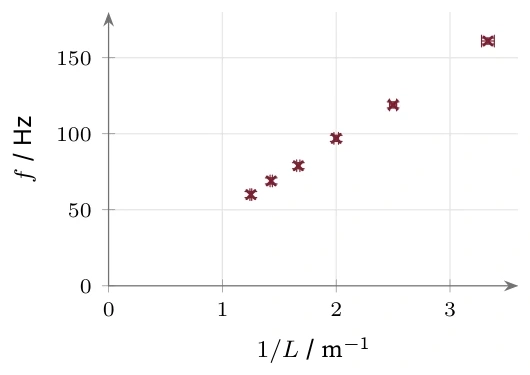
A string is held under constant tension. The length L that vibrates is changed with a movable bridge, and the frequency f of the first harmonic is found for each length. Theory gives f=\dfrac{v}{2L}, where v is the wave speed on the string. L is measured to \pm0.005\,\mathrm{m} and f to \pm2\,\mathrm{Hz}.
\begin{array}{lcccccc}L\text{ / m} & \text{0.300} & \text{0.400} & \text{0.500} & \text{0.600} & \text{0.700} & \text{0.800} \\ f\text{ / Hz} & \text{161} & \text{119} & \text{97} & \text{79} & \text{69} & \text{60}\end{array}
(a) State the quantity that should be plotted on the horizontal axis, with f on the vertical axis, to test the theory. [1]
(b) For L=0.300\,\mathrm{m}, calculate this quantity and its absolute uncertainty. [2]
(c) The best-fit line has gradient 48.3\,\mathrm{m\,s^{-1}}. Determine v. [1]
(d) Lines of maximum and minimum gradient through all the error bars have gradients 51.5 and 45.5\,\mathrm{m\,s^{-1}}. Determine the absolute uncertainty in v and state v to an appropriate number of significant figures. [3]
(e) A second method, timing a pulse along the string, gives v=(91\pm2)\,\mathrm{m\,s^{-1}}. Discuss whether the two results agree. [2]
(f) The best-fit line cuts the f axis at -0.5\,\mathrm{Hz}. Comment. [1]
Diagram for TI question A1
Show solutionHide solution
(a) f=\dfrac v2\cdot\dfrac1L, so plot 1/L (A1); the theory predicts a straight line through the origin of gradient v/2. (b) 1/0.300=3.33\,\mathrm{m^{-1}} (A1); the fractional uncertainty is the same as that of L: 0.005/0.300=1.7\%, so \Delta(1/L)=0.017\times3.33=0.06\,\mathrm{m^{-1}} (A1). (c) v=2\times48.3=97\,\mathrm{m\,s^{-1}} (A1). (d) \Delta(\text{gradient})=(51.5-45.5)/2=3.0\,\mathrm{m\,s^{-1}} (M1); \Delta v=2\times3.0=6\,\mathrm{m\,s^{-1}} (A1); v=(97\pm6)\,\mathrm{m\,s^{-1}}, value and uncertainty to the same place (A1). (e) This experiment: 91 to 103\,\mathrm{m\,s^{-1}}; pulse method: 89 to 93\,\mathrm{m\,s^{-1}} (M1). The ranges overlap, so the results agree within their uncertainties, although the pulse method is far more precise (A1). (f) The intercept is much smaller than the uncertainty of one reading, so it is consistent with zero, as the theory predicts: no evidence of a systematic error in L or f (A1).

Final answer

(a) 1/L. (b) 3.33\,\mathrm{m^{-1}}, \pm0.06\,\mathrm{m^{-1}}. (c) 97\,\mathrm{m\,s^{-1}}. (d) \pm6\,\mathrm{m\,s^{-1}}; v=(97\pm6)\,\mathrm{m\,s^{-1}}. (e) The ranges 91 to 103 and 89 to 93\,\mathrm{m\,s^{-1}} overlap, so they agree. (f) Close to zero compared with the \pm2\,\mathrm{Hz} bars: no sign of a systematic error.

Question A2

Type 12 · Combined chain / P1B[9 marks]
A glider is released from rest on a tilted air track and passes through a light gate a distance s further down the track. The track is tilted by placing a block of height h under one foot; the feet are a distance D apart.
\begin{array}{ll}h=(2.50\pm0.05)\,\mathrm{cm} & D=(100.0\pm0.2)\,\mathrm{cm} \\ s=(0.500\pm0.002)\,\mathrm{m} & \text{card width }w=(2.50\pm0.02)\,\mathrm{cm} \\ \text{gate time }t=(0.0505\pm0.0005)\,\mathrm{s} & \end{array}
(a) Calculate \sin\theta=h/D and its percentage uncertainty. [2]
(b) Show that the acceleration a=\dfrac{w^2}{2st^2} is about 0.25\,\mathrm{m\,s^{-2}}. [2]
(c) Determine g=a/\sin\theta with its absolute uncertainty. [3]
(d) Discuss whether the result is consistent with 9.8\,\mathrm{m\,s^{-2}}. [1]
(e) Identify the measurement that contributes most to the uncertainty and suggest an improvement. [1]
Show solutionHide solution
(a) \sin\theta=2.50/100.0=0.0250 (A1); percentage uncertainty =0.05/2.50+0.2/100.0=2.0\%+0.2\%=2.2\% (A1). (b) v=w/t=0.0250/0.0505=0.495\,\mathrm{m\,s^{-1}} (M1); a=v^2/(2s)=0.495^2/1.000=0.245\,\mathrm{m\,s^{-2}} (A1). (c) g=0.245/0.0250=9.80\,\mathrm{m\,s^{-2}} (A1). Percentage uncertainty: 2\times0.8\% (w) +0.4\% (s) +2\times1.0\% (t) +2.2\% (\sin\theta) =6.2\% (M1); \Delta g=0.062\times9.80=0.6\,\mathrm{m\,s^{-2}}, so g=(9.8\pm0.6)\,\mathrm{m\,s^{-2}} (A1). (d) 9.8 lies inside 9.2 to 10.4\,\mathrm{m\,s^{-2}}, so the result is consistent (A1). (e) The block height (2.0\%, tied with the doubled timing term): a taller block on a longer track halves its share, or a caliper reads h to \pm0.01\,\mathrm{cm}; for the time, a wider card gives a longer, relatively more precise gate time (A1).

Final answer

(a) 0.0250; 2.2\%. (b) v=0.495\,\mathrm{m\,s^{-1}}, a=0.245\,\mathrm{m\,s^{-2}}. (c) 6.2\%; g=(9.8\pm0.6)\,\mathrm{m\,s^{-2}}. (d) Yes, 9.8 lies in 9.2 to 10.4. (e) h (2.0\%): use a taller block with a longer track (or measure h with a caliper); or time t (2.0\%): use a wider card.

Question A3

Type 18 · Log plots / P1B[8 marks]
A beaker of hot water cools in a room. The difference \Delta\theta between the water temperature and the room temperature is expected to fall exponentially with time t.
\begin{array}{lccccccc}t\text{ / min} & \text{0} & \text{2} & \text{4} & \text{6} & \text{8} & \text{10} & \text{12} \\ \Delta\theta\text{ / K} & \text{60.0} & \text{47.2} & \text{37.1} & \text{31.6} & \text{23.0} & \text{18.1} & \text{14.2}\end{array}
(a) Use the data from t=0 to t=4\,\mathrm{min} to show that \Delta\theta falls by a constant factor in equal times. [2]
(b) Identify the reading that does not fit, and state what the student should do. [1]
(c) A graph of \ln(\Delta\theta/\mathrm K) against t is a straight line of gradient -k. Use the readings at t=0 and t=12\,\mathrm{min} to find k, and hence the time for \Delta\theta to halve. [3]
(d) The water thermometer reads 0.5\,\mathrm{K} too high at every temperature and the room temperature is read with a different, correct thermometer. Explain the effect on the \ln graph. [2]
Show solutionHide solution
(a) Ratios over successive 2\,\mathrm{min} intervals: 47.2/60.0=0.787 and 37.1/47.2=0.786 (M1); equal ratios in equal times are the signature of exponential decay (A1). (b) The value at 6\,\mathrm{min}: 31.6\,\mathrm{K}, against about 0.786\times37.1=29.2\,\mathrm{K} from the pattern (the ratios either side of it are 0.852 and 0.728). Check or repeat it and give the reason if it is left out of the fit (A1). (c) Gradient =\dfrac{\ln14.2-\ln60.0}{12-0}=\dfrac{2.653-4.094}{12}=-0.120\,\mathrm{min^{-1}}, so k=0.120\,\mathrm{min^{-1}} (M1 A1); halving time =\ln2/k=0.693/0.120=5.8\,\mathrm{min} (A1). (d) Each \Delta\theta is 0.5\,\mathrm{K} too large (M1). That is a small fraction at 60\,\mathrm{K} but 3.5\% at 14\,\mathrm{K}, so the late points lie above the true line: the graph curves upwards at large t and its gradient is less steep, giving k too small (A1). With the same thermometer for water and room, the offset would cancel.

Final answer

(a) 47.2/60.0=0.787, 37.1/47.2=0.786: the same factor. (b) 31.6\,\mathrm{K} at 6\,\mathrm{min} (expected about 29.2\,\mathrm{K}): repeat or check it; do not use it in the fit unless it is confirmed. (c) k=0.120\,\mathrm{min^{-1}}; halving time 5.8\,\mathrm{min}. (d) Every \Delta\theta is 0.5\,\mathrm{K} too large; the effect is largest at small \Delta\theta, so the graph curves at late times and the fitted k is too small.

Question A4

Type 24 · Ratio / proportion / P1B[7 marks]
A student drops a ball from height h onto a hard floor and films the bounce at 60 frames per second to find the rebound height r (mean of three drops).
\begin{array}{lccccc}h\text{ / m} & \text{0.40} & \text{0.60} & \text{0.80} & \text{1.00} & \text{1.20} \\ r\text{ / m} & \text{0.29} & \text{0.43} & \text{0.58} & \text{0.71} & \text{0.86}\end{array}
(a) Use the data to show that r is approximately proportional to h. [2]
(b) Determine the fraction of the ball's energy lost in one bounce. [1]
(c) The top of the rebound is read from the frame in which the ball is highest, to \pm1\,\mathrm{cm}. Explain which value of h gives the largest percentage uncertainty in r. [2]
(d) Suggest one improvement linked to (c). [1]
(e) Suggest why the ratio r/h might fall for drops from much greater heights. [1]
Show solutionHide solution
(a) r/h: 0.29/0.40=0.725, 0.43/0.60=0.717, 0.58/0.80=0.725, 0.71/1.00=0.710, 0.86/1.20=0.717 (M1); the ratio is constant to within the reading uncertainty (about \pm0.01), so r\propto h (A1). A graph of r against h through the origin is the alternative test. (b) The energy left after the bounce is mgr out of mgh: fraction lost =1-0.72=0.28 (A1). (c) \pm1\,\mathrm{cm} is a fixed absolute uncertainty (M1), so the percentage is largest when r is smallest: 1/29=3.4\% at h=0.40\,\mathrm{m}, against 1/86=1.2\% at 1.20\,\mathrm{m} (A1). (d) Any one linked to reading r: more frames per second so the highest frame is closer to the true top; the camera at the height of the top of the bounce to remove parallax; repeat more drops at the small heights (A1). (e) The ball moves faster for larger h, so air resistance takes a larger fraction of its energy on the way down and up (A1).

Final answer

(a) r/h=0.725, 0.717, 0.725, 0.710, 0.717: constant within about 1\%, mean 0.72. (b) About 0.28. (c) h=0.40\,\mathrm{m}: 1/29=3.4\%, the largest because r is smallest. (d) A higher frame rate or a camera level with the top of the bounce, or a larger ruler scale behind the ball. (e) Air resistance grows with speed and takes a larger share of the energy.

Connected questions

Question C1

Connected · motion and energy / P2 / TI + A.1 + A.3[8 marks]
A trolley rolls from rest down a ramp. A w=(4.00\pm0.05)\,\mathrm{cm} card blocks a light gate at the bottom for t=(0.080\pm0.002)\,\mathrm{s}. The trolley mass is (0.600\pm0.005)\,\mathrm{kg} and its vertical drop is (0.020\pm0.001)\,\mathrm{m}.
(a) Find the speed and its percentage uncertainty. [3]
(b) Calculate the kinetic energy as a percentage of the gravitational potential energy lost. [2]
(c) Find the percentage uncertainty of this energy fraction and decide whether the data support negligible energy loss. Use g=9.8\,\mathrm{m\,s^{-2}}. [3]
Show solutionHide solution
(a) Convert the card width first: w=0.0400\,\mathrm{m}. Then v=w/t=0.500\,\mathrm{m\,s^{-1}}. For a quotient, \Delta v/v=0.0005/0.0400+0.002/0.080=0.0375, or 3.75\%.
(b) E_\mathrm{k}=\tfrac12(0.600)(0.500)^2=0.0750\,\mathrm{J} and \Delta E_\mathrm{p}=(0.600)(9.8)(0.020)=0.1176\,\mathrm{J}. Their ratio is 0.6378, or 64\%.
(c) Cancel the common mass before propagating: f=v^2/(2gh). Its fractional uncertainty is 2(3.75\%)+5.0\%=12.5\%. Thus \Delta f=0.0797 and f=(64\pm8)\%. The interval 56–72% excludes 100%, so the data resolve energy loss; negligible loss is not supported.

Final answer

(a) 0.500\,\mathrm{m\,s^{-1}}, 3.75\%. (b) 64\%. (c) 12.5\% of the fraction, so (64\pm8)\%: loss is resolved.

Question C2

Connected · circuits and heating / P2 / TI + B.1 + B.5[8 marks]
A resistor heats (0.200\pm0.002)\,\mathrm{kg} of water. The p.d. is (6.00\pm0.05)\,\mathrm{V} and the current is (2.00\pm0.02)\,\mathrm{A}. A graph of temperature against time has gradient (0.0130\pm0.0005)\,\mathrm{K\,s^{-1}}. Assume initially that all the electrical energy heats the water.
(a) Show how the gradient gives the specific heat capacity. [2]
(b) Determine that capacity with its uncertainty. [3]
(c) Compare with 4180\,\mathrm{J\,kg^{-1}\,K^{-1}}. Explain the direction of any discrepancy and give one practical improvement. [3]
Show solutionHide solution
(a) VIt=mc\Delta T, so the temperature gradient s=\Delta T/t=VI/(mc) and c=VI/(ms).
(b) c=6.00(2.00)/(0.200\times0.0130)=4615\,\mathrm{J\,kg^{-1}\,K^{-1}}. The fractional uncertainty is 0.05/6.00+0.02/2.00+0.002/0.200+0.0005/0.0130=0.0668. Therefore \Delta c=308\,\mathrm{J\,kg^{-1}\,K^{-1}} and c=(4.6\pm0.3)\times10^3\,\mathrm{J\,kg^{-1}\,K^{-1}}.
(c) The rounded range 4300–4900 does not include 4180. Energy reaching the surroundings or warming the container reduces the water’s temperature gradient, so VI/(ms) overestimates c. Insulate the vessel and add a lid to reduce heat transfer; account separately for container heating.

Final answer

(a) c=VI/(m\times\text{gradient}). (b) (4.6\pm0.3)\times10^3\,\mathrm{J\,kg^{-1}\,K^{-1}}. (c) No overlap with 4180; heat loss or heating the container raises the apparent c; insulate and use a lid.

Question C3

Connected · radiation and orbital data / P2 / TI + C.2 + D.1[8 marks]
A star’s irradiance is measured at three orbital radii. The pairs (r,I) are (1.0,900), (1.5,400) and (2.0,225), with r in 10^{11}\,\mathrm{m} and I in \mathrm{W\,m^{-2}}. Each irradiance has uncertainty \pm5\%; each radius has uncertainty \pm2\%. The planets have nearly circular orbits.
(a) Calculate a quantity that tests an inverse-square law, using all three pairs. [2]
(b) Determine the stellar luminosity and its percentage uncertainty from the first pair. [3]
(c) Find the ratio of the outer planet’s orbital period to the inner planet’s. Explain why a straight \log I against \log r line alone would not establish the orbital-period law. [3]
Show solutionHide solution
(a) In SI units, each product Ir^2 is 9.0\times10^{24}\,\mathrm{W}: 900(10^{11})^2, 400(1.5\times10^{11})^2 and 225(2.0\times10^{11})^2. A constant product supports I\propto r^{-2}.
(b) L=4\pi r^2I=4\pi(9.0\times10^{24})=1.13\times10^{26}\,\mathrm{W}. The fractional uncertainty is 2\Delta r/r+\Delta I/I=2(2\%)+5\%=9\%, corresponding to about 1.0\times10^{25}\,\mathrm{W}.
(c) For planets orbiting the same mass, T^2\propto r^3. Thus T_\mathrm{out}/T_\mathrm{in}=(2.0/1.0)^{3/2}=2.83. A log irradiance graph tests the radiation relation with slope -2; it measures no orbital periods. Testing the orbital law requires period data as well as radii.

Final answer

(a) Ir^2=9.0\times10^{24}\,\mathrm{W} for each. (b) L=1.13\times10^{26}\,\mathrm{W}, 9\%. (c) T_\text{out}/T_\text{in}=2.83; the irradiance plot contains no period measurements.

Question C4

Connected · gas and electrical heating / P2 / TI + B.3 + B.5[9 marks]
A rigid vessel contains a monatomic ideal gas. Initially p=(1.20\pm0.02)\times10^5\,\mathrm{Pa}, V=(1.00\pm0.01)\times10^{-3}\,\mathrm{m^3} and T=(300\pm1)\,\mathrm{K}. A heater at 6.0\,\mathrm{V} carries 1.0\,\mathrm{A} for 10\,\mathrm{s}. The final gas temperature is 350\,\mathrm{K}; no gas escapes.
(a) Determine the amount of gas, with its percentage uncertainty. Use R=8.31\,\mathrm{J\,mol^{-1}\,K^{-1}}. [3]
(b) Find the increase in internal energy, using U=\tfrac32nRT. [2]
(c) Calculate the fraction of the electrical energy stored as extra gas internal energy. [2]
(d) Give one reason for the difference between the two energies and one change to investigate it. [2]
Show solutionHide solution
(a) n=pV/(RT)=120/(8.31\times300)=0.0481\,\mathrm{mol}. Add fractional uncertainties: 0.02/1.20+0.01/1.00+1/300=0.0300, or 3.0\%.
(b) The temperature rises by 50\,\mathrm{K}. Hence \Delta U=\tfrac32nR\Delta T=\tfrac32(0.0481)(8.31)(50)=30\,\mathrm{J} to two significant figures. Equivalently, the initial nRT=pV=120\,\mathrm{J} and the fractional temperature increase is 50/300, giving the same result.
(c) The heater delivers E=VIt=(6.0)(1.0)(10)=60\,\mathrm{J}. The fraction in the gas is \Delta U/E=30/60=0.50.
(d) Some supplied energy warms the vessel or passes to the room. Measure the vessel’s temperature change and account for its energy gain, or add insulation and repeat the run to test the heat-loss explanation.

Final answer

(a) 0.0481\,\mathrm{mol}, 3.0\%. (b) 30\,\mathrm{J}. (c) 0.50. (d) Vessel heating or heat loss; measure the vessel’s temperature rise or improve insulation.

From the book

Photon Physics: Study Guide for the IB Diploma (SL & HL)

Tools and inquiry from the core ideas to full exam questions, with question types, worked examples and graded practice.

About the book