Free worked solutions · 2026 Edition

IB Physics E.3: Radioactive decay worked solutions

Worked solutions to every practice question in E.3: Radioactive decay of Photon Physics: Study Guide for the IB Diploma (SL & HL). Try each question, then compare your working with the full solution.

  • SL & HL
  • 32 questions
  • Full worked solutions
  • Free, no sign-up

Basic practice

Question A1

Type A1 · P1A · Notation; options: protons / neutrons / nucleons[1 mark]
A nucleus of cobalt-60 has proton number 27. Which row gives the numbers of particles in this nucleus?
| protons | neutrons | nucleons
A. | 27 | 33 | 60
B. | 33 | 27 | 60
C. | 27 | 60 | 87
D. | 60 | 27 | 87
Show solutionHide solution
The lower number is Z=27 protons; the upper number is the nucleon number A=60; neutrons N=A-Z=33. B swaps protons and neutrons; C and D treat 60 as the neutron or proton count and add the two numbers.

Final answer

A
Question A2

Type A2 · P1A · Isotope evidence[1 mark]
Two pure samples, P and Q, are tested in a laboratory. Which observation shows that P and Q are isotopes of the same element?
A. P and Q have the same half-life.
B. P and Q take part in the same chemical reactions, but the masses of their atoms differ.
C. The nuclei of P and Q have the same nucleon number.
D. P and Q emit the same type of radiation.
Show solutionHide solution
Isotopes have the same proton number, so the same electron arrangement and the same chemistry, but different neutron numbers, so different masses. A is wrong: isotopes of one element usually have very different half-lives (or are stable). C describes nuclei of different elements with equal A. D says nothing about the proton number.

Final answer

B

Question A3

Type A3 · P1A · Mass units[1 mark]
Which of the following is NOT a mass?
A. 0.000\,549\,\mathrm{u}   B. 0.511\,\mathrm{MeV\,c^{-2}}   C. 0.511\,\mathrm{MeV}   D. 9.11\times10^{-31}\,\mathrm{kg}
Show solutionHide solution
The unified mass unit u, the \mathrm{MeV\,c^{-2}} and the kilogram are all mass units; these are three ways of writing the electron's rest mass. The MeV on its own is an energy: 0.511\,\mathrm{MeV} is the electron's rest energy, mc^2.

Final answer

C

Question B1

Type B1 · P1A · BE curve[1 mark]
Which nuclide has the greatest binding energy per nucleon?
A. {}^{56}_{26}\mathrm{Fe}   B. {}^{4}_{2}\mathrm{He}   C. {}^{208}_{82}\mathrm{Pb}   D. {}^{235}_{92}\mathrm{U}
Show solutionHide solution
The binding-energy-per-nucleon curve peaks near A=60; iron-56 sits at the top at about 8.8\,\mathrm{MeV} per nucleon. Helium-4 (7.1\,\mathrm{MeV}) is a high point among the light nuclei but well below the peak; lead and uranium lie on the slow decline beyond it.

Final answer

A

Question B2

Type B2 · P1A · BE/nucleon[1 mark]
The binding energy per nucleon of zirconium-90, {}^{90}_{40}\mathrm{Zr}, is 8.71\,\mathrm{MeV}. What is the minimum energy needed to separate one nucleus of zirconium-90 into its individual protons and neutrons?
A. 8.71\,\mathrm{MeV}   B. 348\,\mathrm{MeV}   C. 436\,\mathrm{MeV}   D. 784\,\mathrm{MeV}
Show solutionHide solution
Total binding energy =A\times (binding energy per nucleon) =90\times8.71=784\,\mathrm{MeV}. A is the value for one nucleon; B multiplies by the proton number 40 and C by the neutron number 50.

Final answer

D

Question C1

Type C1 · P1A · Radiation[1 mark]
Which statement about alpha, beta-minus and gamma radiation is correct?
A. Gamma radiation is the most strongly ionizing of the three.
B. Beta-minus particles and alpha particles bend the same way in a magnetic field.
C. Alpha particles are stopped by a few centimetres of air.
D. Gamma rays travel more slowly than beta-minus particles.
Show solutionHide solution
Alpha particles ionize so strongly that they lose all their energy in a few centimetres of air. Gamma rays are the weakest ionizers (A); beta-minus particles are negative and alpha particles positive, so they bend opposite ways (B); gamma rays travel at c, faster than any beta particle (D).

Final answer

C

Question C2

Type C2 · P1A · Decay statements[1 mark]
Which statement about a sample of a radioactive isotope is correct?
A. Heating the sample to 400\,{}^{\circ}\mathrm{C} shortens its half-life.
B. A sample with more nuclei of the isotope has a greater activity.
C. A nucleus that survives one half-life is certain to decay during the next one.
D. The moment at which one particular nucleus decays can be calculated from the half-life.
Show solutionHide solution
Each nucleus has the same small chance of decaying per second, so more nuclei give more decays per second: B. A fails because decay is spontaneous; temperature, pressure and chemical bonding leave the half-life alone. C and D fail because decay is random: a nucleus has no memory, and only a probability can be given for any one nucleus.

Final answer

B

Question C3

Type C3 · P1A · Equations; options: X / Y[1 mark]
Fluorine-18 decays by beta-plus emission: {}^{18}_{9}\mathrm{F}\;\to\;\mathrm{X}+{}^{\;\;0}_{+1}\mathrm{e}+\mathrm{Y} What are X and Y?
| X | Y
A. | {}^{18}_{8}\mathrm{O} | neutrino
B. | {}^{18}_{8}\mathrm{O} | antineutrino
C. | {}^{18}_{10}\mathrm{Ne} | neutrino
D. | {}^{18}_{10}\mathrm{Ne} | antineutrino
Show solutionHide solution
In beta-plus decay a proton becomes a neutron: A stays 18, Z falls from 9 to 8 (oxygen), and the positron is accompanied by a neutrino. The antineutrino goes with beta-minus decay (B, D); C and D move Z the beta-minus way.

Final answer

A

Question D1

Type D1 · P1A · Halvings[1 mark]
Iodine-131 has a half-life of 8.0 days. What fraction of a sample of iodine-131 has decayed after 24 days?
A. \tfrac18   B. \tfrac13   C. \tfrac23   D. \tfrac78
Show solutionHide solution
24 days is 3 half-lives, so (\tfrac12)^3=\tfrac18 remains and 1-\tfrac18=\tfrac78 has decayed. A is the fraction remaining; B and C wrongly treat the decay as linear.

Final answer

D

Question A4

Type A4 · P1A · Forces[1 mark]
Two protons in a nucleus are 1.5\,\mathrm{fm} apart. Which statement about the forces between them is correct?
A. Their gravitational attraction balances their electric repulsion.
B. The strong nuclear force acts only between a proton and a neutron, not between two protons.
C. The electric force between them is attractive at this short distance.
D. The strong nuclear force between them is attractive and larger than their electric repulsion.
Show solutionHide solution
At about 1.5\,\mathrm{fm} the strong force attracts any two nucleons, proton or neutron, and outweighs the electric repulsion of about 100\,\mathrm{N}. Gravity is some 10^{36} times too weak (A); the strong force acts between all nucleons (B); two positive charges always repel (C).

Final answer

D

Question F1

Type F1 · P1A · Probability · HL[1 mark]
Sodium-24 has a half-life of 15.0 hours. What is the probability that a particular sodium-24 nucleus decays in the next second?
A. 1.3\times10^{-5}   B. 1.9\times10^{-5}   C. 4.6\times10^{-2}   D. 7.8\times10^{4}
Show solutionHide solution
\lambda=\ln2/T_{1/2}=0.693/(15.0\times3600\,\mathrm{s})=1.28\times10^{-5}\,\mathrm{s^{-1}}. Since \lambda\Delta t\ll1, the probability is \lambda\Delta t=1.3\times10^{-5}. B leaves out \ln2; C uses hours for a one-second interval; D is 1/\lambda, a time, and no probability exceeds 1.

Final answer

A

Question G1

Type G1 · P1A · N/Z stability · HL; options: decay / daughter[1 mark]
Carbon-11, {}^{11}_{6}\mathrm{C}, has fewer neutrons than the stable carbon isotopes. Which decay is it most likely to undergo, and what is the daughter nucleus?
| decay | daughter
A. | beta-minus | {}^{11}_{7}\mathrm{N}
B. | beta-plus | {}^{11}_{5}\mathrm{B}
C. | alpha | {}^{7}_{4}\mathrm{Be}
D. | beta-plus | {}^{11}_{7}\mathrm{N}
Show solutionHide solution
Carbon-11 lies below the band of stability (too few neutrons for its protons). Beta-plus decay turns a proton into a neutron, raising N/Z: Z falls to 5 (boron) with A=11 unchanged. A would make the neutron shortage worse; alpha decay is for heavy nuclei; D moves Z the wrong way for beta-plus.

Final answer

B

Tutorial practice

Question E1

Type E1 · P2 · Isotope choice[5 marks]
A water main buried 1.5\,\mathrm{m} under a road is leaking. Engineers will add a small amount of a radioactive isotope to the water and search for it from the road surface. The search takes about one day, and the activity left in the ground should become negligible within a week.
isotope | radiation emitted | half-life
strontium-90 | beta-minus | 29 years
sodium-24 | beta-minus and gamma | 15 hours
polonium-210 | alpha | 138 days
cobalt-60 | beta-minus and gamma | 5.3 years
iodine-131 | beta-minus and gamma | 8.0 days
(a) Explain why polonium-210 is unsuitable. [1]
(b) Choose the most suitable isotope. Justify your choice by referring both to the radiation it emits and to its half-life. [3]
(c) Calculate the fraction of the initial activity of your chosen isotope that remains 75 hours after it is added. [1]
Show solutionHide solution
(a) Alpha particles are stopped by a few centimetres of air or a sheet of paper, so none would reach the road surface (A1). (b) Sodium-24 (A1). It emits gamma rays, which penetrate 1.5\,\mathrm{m} of soil and can be detected at the surface (A1). Its half-life of 15 hours leaves about a third of the activity after one day, enough to trace the leak, while after a week (11 half-lives) less than 0.1\% remains; iodine-131 and cobalt-60 would stay active for weeks or years (A1). (c) 75 hours is 5 half-lives: (\tfrac12)^5=\tfrac1{32} (A1).

Final answer

(a) its alpha particles cannot pass through 1.5\,\mathrm{m} of soil (b) sodium-24: gamma reaches the surface; 15 hours is long enough for a day's search and short enough to decay within a week (c) \tfrac{1}{32}

Question G2

Type G2 · P1A · Levels · HL; options: photon energy / evidence for[1 mark]
A nucleus decays by alpha emission, either directly to the ground state of the daughter nucleus or to an excited state of the daughter, which then emits a gamma photon. The alpha particles are found with only two energies, 4.88\,\mathrm{MeV} and 4.69\,\mathrm{MeV} (ignore the recoil of the daughter). What is the energy of the gamma photon, and what does the existence of these fixed energies show?
| photon energy | evidence for
A. | 0.19\,\mathrm{MeV} | nuclear energy levels
B. | 0.19\,\mathrm{MeV} | atomic energy levels
C. | 9.57\,\mathrm{MeV} | nuclear energy levels
D. | 4.69\,\mathrm{MeV} | nuclear energy levels
Show solutionHide solution
Both paths start at the parent and end at the daughter's ground state, so the photon carries the difference: 4.88-4.69=0.19\,\mathrm{MeV}. Fixed alpha and gamma energies mean the nucleus has discrete energy levels. Atomic levels are separated by electronvolts, not 0.19\,\mathrm{MeV} (B); C adds instead of subtracting; D gives the whole alpha energy to the photon.

Final answer

A

Question F3

Type F3 · P1A · Graph tools · HL[1 mark]
A graph of \ln(A/\mathrm{Bq}) against t, where A is the activity of a source and t is in hours, is a straight line with gradient -0.0866\,\mathrm{h^{-1}}. What is the half-life of the source?
A. 0.060\,\mathrm{h}   B. 11.5\,\mathrm{h}   C. 8.0\,\mathrm{h}   D. 16\,\mathrm{h}
Show solutionHide solution
\ln A=\ln A_0-\lambda t, so the gradient is -\lambda: \lambda=0.0866\,\mathrm{h^{-1}} and T_{1/2}=\ln2/\lambda=0.693/0.0866=8.0\,\mathrm{h}. A multiplies by \ln2; B takes the reciprocal of the gradient without \ln2; D doubles the half-life.

Final answer

C

Question A5

Type A5 · P1A · Induced change[1 mark]
Which equation shows an artificial transmutation?
A. {}^{238}_{92}\mathrm{U}\to{}^{234}_{90}\mathrm{Th}+{}^{4}_{2}\mathrm{He}
B. {}^{1}_{0}\mathrm{n}\to{}^{1}_{1}\mathrm{p}+{}^{\;\;0}_{-1}\mathrm{e}+\bar{\nu}
C. {}^{4}_{2}\mathrm{He}+{}^{27}_{13}\mathrm{Al}\to{}^{30}_{15}\mathrm{P}+{}^{1}_{0}\mathrm{n}
D. {}^{99}_{43}\mathrm{Tc}^{*}\to{}^{99}_{43}\mathrm{Tc}+\gamma
Show solutionHide solution
An artificial transmutation needs an incoming particle on the left: here an alpha particle strikes aluminium-27 and makes a new element, phosphorus-30. A, B and D have a single unstable particle on the left: they are spontaneous decays, even though A and B also change the element.

Final answer

C

Question D2

Type D2 · P1A · Ratios[1 mark]
Radioactive sources X and Y have the same activity at t=0. The half-life of X is 2.0\,\mathrm{h} and the half-life of Y is 3.0\,\mathrm{h}. What is \dfrac{\text{activity of X}}{\text{activity of Y}} at t=6.0\,\mathrm{h}?
A. \tfrac23   B. \tfrac32   C. 2   D. \tfrac12
Show solutionHide solution
In 6.0\,\mathrm{h} X goes through 3 half-lives (factor \tfrac18) and Y through 2 (factor \tfrac14). Ratio =\tfrac18\div\tfrac14=\tfrac12. A and B are the ratio of the half-lives, not of the activities; C inverts the answer.

Final answer

D

Question D3

Type D3 · P2 · Half-life plot, Halvings[4 marks]
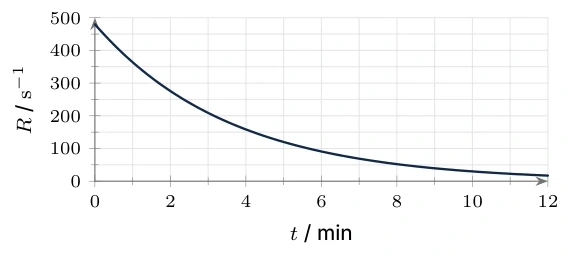
Figure FD3 shows the corrected count rate R (background already subtracted) from a sample of a radioactive isotope against time t.
(a) Use the graph to determine the half-life of the isotope, in seconds. [2]
(b) Explain why the time for R to fall from 300\,\mathrm{s^{-1}} to 150\,\mathrm{s^{-1}} is also one half-life. [1]
(c) Determine R at t=12.5\,\mathrm{min}. [1]
Diagram for E.3 question D3
Show solutionHide solution
(a) R falls from 480\,\mathrm{s^{-1}} to 240\,\mathrm{s^{-1}} in 2.5\,\mathrm{min}, and from 240 to 120\,\mathrm{s^{-1}} in the next 2.5\,\mathrm{min}: two halvings read and checked (M1). T_{1/2}=2.5\times60=150\,\mathrm{s}, converted to seconds (A1). (b) The number of nuclei decaying per second is proportional to the number left, so the curve takes the same time to halve from any starting value (A1). (c) 12.5\,\mathrm{min} is 5 half-lives: 480/2^5=15\,\mathrm{s^{-1}} (A1).

Final answer

(a) 150\,\mathrm{s} (b) the fall in any time interval is the same fraction of the starting value: exponential decay (c) 15\,\mathrm{s^{-1}}

Question D4

Type D4 · P2 · Background, Halvings[4 marks]
A detector placed near a source of a beta emitter records 925 counts per minute. With the source removed it records 25 counts per minute. The half-life of the isotope is 3.0\,\mathrm{h}.
(a) Calculate the count rate due to the source alone. [1]
(b) Determine the count rate the detector will record 9.0\,\mathrm{h} later, with the source in the same place. [2]
(c) A student says that after a very long time the detector will record nothing. Comment on this. [1]
Show solutionHide solution
(a) 925-25=900 counts per minute (A1). (b) 9.0\,\mathrm{h} is 3 half-lives, so the source contributes 900/8=112.5 counts per minute; halve the net rate, not the total (M1). The detector records 112.5+25\approx138 counts per minute (A1). Halving 925 three times would give 116, which is wrong. (c) The source's contribution falls towards zero, but the background remains, so the reading tends to about 25 counts per minute, not zero (A1).

Final answer

(a) 900 counts per minute (b) about 138 counts per minute (c) it will settle at the background, about 25 counts per minute

Question B3

Type B3 · P2 · Mass-Q, Mass units[6 marks]
Cobalt-60 decays by beta-minus emission to nickel-60. Atomic masses: cobalt-60 59.933\,817\,\mathrm{u}, nickel-60 59.930\,786\,\mathrm{u}. Molar mass of cobalt-60 =59.93\,\mathrm{g\,mol^{-1}}.
(a) Write the equation for this decay, including the proton and nucleon numbers (Z=27 for cobalt). [1]
(b) When atomic masses are used, the mass of the emitted electron need not be added to the products. Explain why. [1]
(c) Calculate the energy released in one decay, in MeV. [2]
(d) Calculate the total energy, in J, released when 1.0\,\mathrm{mg} of cobalt-60 decays completely. [2]
Show solutionHide solution
(a) {}^{60}_{27}\mathrm{Co}\to{}^{60}_{28}\mathrm{Ni}+{}^{\;\;0}_{-1}\mathrm{e}+\bar{\nu}, with the antineutrino (A1). (b) The parent atom carries 27 electrons and the daughter atom 28; the extra electron counted in the nickel atomic mass stands in for the emitted beta particle, so the electron masses balance (A1). (c) \Delta m=59.933\,817-59.930\,786=0.003\,031\,\mathrm{u} (M1); E=0.003\,031\times931.5=2.82\,\mathrm{MeV} (A1). (d) Number of nuclei =\dfrac{1.0\times10^{-3}}{59.93}\times6.02\times10^{23}=1.0\times10^{19} (M1); energy =1.0\times10^{19}\times2.82\times1.60\times10^{-13}=4.5\times10^{6}\,\mathrm{J} (A1).

Final answer

(a) {}^{60}_{27}\mathrm{Co}\to{}^{60}_{28}\mathrm{Ni}+{}^{\;\;0}_{-1}\mathrm{e}+\bar{\nu} (b) the nickel atom's 28 electrons already include one more electron than the cobalt atom's 27 (c) 2.82\,\mathrm{MeV} (d) 4.5\times10^{6}\,\mathrm{J}

Question F2

Type F2 · P2 · Activity, Exponential · HL[5 marks]
A hospital receives a capsule containing iodine-131. At delivery its activity is 3.7\times10^{8}\,\mathrm{Bq}. The half-life of iodine-131 is 8.02 days and its molar mass is 131\,\mathrm{g\,mol^{-1}}.
(a) Calculate the decay constant of iodine-131, in \mathrm{s^{-1}}. [1]
(b) Determine the number of iodine-131 nuclei in the capsule at delivery. [1]
(c) Calculate the mass of iodine-131 in the capsule, in \mathrm{\mu g}. [1]
(d) The capsule is given to a patient 2.5 days after delivery. Calculate its activity at that time. [2]
Show solutionHide solution
(a) \lambda=\ln2/(8.02\times86\,400)=1.00\times10^{-6}\,\mathrm{s^{-1}} (A1). (b) N=A/\lambda=3.7\times10^{8}/1.00\times10^{-6}=3.7\times10^{14} (A1). (c) m=\dfrac{3.7\times10^{14}}{6.02\times10^{23}}\times131\,\mathrm{g}=8.0\times10^{-8}\,\mathrm{g}=0.080\,\mathrm{\mu g} (A1): a tiny mass gives a large activity. (d) \lambda t=1.00\times10^{-6}\times2.5\times86\,400=0.216 (M1); A=3.7\times10^{8}\,e^{-0.216}=3.0\times10^{8}\,\mathrm{Bq} (A1).

Final answer

(a) 1.00\times10^{-6}\,\mathrm{s^{-1}} (b) 3.7\times10^{14} (c) 0.080\,\mathrm{\mu g} (d) 3.0\times10^{8}\,\mathrm{Bq}

Question C4

Type C4 · P1A · Chains[1 mark]
A nucleus of lead-214, {}^{214}_{82}\mathrm{Pb}, emits a beta-minus particle, then a second beta-minus particle, then an alpha particle. How many neutrons does the final nucleus contain?
A. 126   B. 128   C. 130   D. 132
Show solutionHide solution
Two beta-minus emissions: Z=82\to84, A=214. Then alpha: Z=82, A=210. Neutrons =210-82=128: recompute A-Z at the end. D is the starting neutron number; C keeps N fixed through the beta decays; A forgets that the alpha particle takes two protons.

Final answer

B

Advanced practice

Question B4

Type B4 · P2 · Binding-Q, Mass units[8 marks]
Uranium-234 decays by alpha emission to thorium-230: {}^{234}_{\;92}\mathrm{U}\;\to\;{}^{230}_{\;90}\mathrm{Th}+{}^{4}_{2}\mathrm{He} Binding energies per nucleon: uranium-234 7.6005\,\mathrm{MeV}, thorium-230 7.6310\,\mathrm{MeV}, helium-4 7.0739\,\mathrm{MeV}.
(a) Explain, in terms of binding energy, why energy is released in this decay. [1]
(b) Calculate the energy released in one decay. [3]
(c) State how the total mass of the products compares with the mass of the uranium-234 nucleus. [1]
(d) Calculate the difference between these masses, in kg. [2]
(e) A student calculates 7.6310+7.0739-7.6005 to find the energy released. Explain why this is wrong. [1]
Show solutionHide solution
(a) The total binding energy of thorium-230 plus the alpha particle is greater than that of uranium-234; the difference is released, mostly as kinetic energy (A1). (b) Totals: 230\times7.6310=1755.13\,\mathrm{MeV} and 4\times7.0739=28.30\,\mathrm{MeV} (M1); 234\times7.6005=1778.52\,\mathrm{MeV} (M1); energy released =1755.13+28.30-1778.52=4.91\,\mathrm{MeV} (A1). (c) Less: the products are more tightly bound, so their total mass is smaller (A1). (d) \Delta m=4.909/931.5=5.27\times10^{-3}\,\mathrm{u} (M1) =5.27\times10^{-3}\times1.661\times10^{-27}=8.75\times10^{-30}\,\mathrm{kg} (A1). (e) Binding energy per nucleon is an average; the energies to compare are the totals, binding energy per nucleon times nucleon number, for every nucleus (A1).

Final answer

(a) the products have more total binding energy than the parent (b) 4.91\,\mathrm{MeV} (c) the products have less mass (d) 8.75\times10^{-30}\,\mathrm{kg} (e) binding energies per nucleon must be multiplied by the nucleon numbers before they are compared

Question E2

Type E2 · P2 · Thickness gauge, Background[7 marks]
Aluminium foil leaves a set of rollers and passes between a beta source, strontium-90 (half-life 29 years), and a detector. With foil of the correct thickness the detector records 1530 counts per minute; the background count rate is 30 counts per minute. A controller adjusts the gap between the rollers using the detector reading.
(a) Explain why a beta source is used rather than an alpha or a gamma source. [2]
(b) During a run the reading rises to 1830 counts per minute. State and explain what has happened to the foil, and how the controller should adjust the rollers. [2]
(c) Explain why a source with a half-life of 29 years is chosen rather than one with a half-life of a few hours. [1]
(d) The same source is still in use 29 years later. Calculate the reading the detector should then give for foil of the correct thickness. [2]
Show solutionHide solution
(a) Alpha particles would be absorbed completely by the foil, so no change of thickness could be detected (A1). Gamma rays would pass through almost unaffected; beta particles are partly absorbed, so the count rate changes noticeably with thickness (A1). (b) A higher count rate means less absorption, so the foil has become thinner (A1); the controller should increase the gap between the rollers, reducing the squeeze on the foil (A1). (c) Over days or months the source's own activity hardly changes, so any change in the reading is due to the foil and not to the source decaying (A1). (d) The source part of the reading is 1530-30=1500 counts per minute; after one half-life it is 750 (M1); the detector records 750+30=780 counts per minute (A1).

Final answer

(a) alpha would be stopped by the foil; gamma would pass almost unaffected; beta is partly absorbed, so the count depends on thickness (b) the foil is too thin: less absorption; widen the gap between the rollers (c) the count rate stays almost constant during production, so changes come from the foil (d) 780 counts per minute

Question E3

Type E3 · P2 · Dating, Chains[7 marks]
Uranium-238, {}^{238}_{\;92}\mathrm{U}, decays through a chain of short-lived nuclides to stable lead-206, {}^{206}_{\;82}\mathrm{Pb}. Treat the chain as a single decay with a half-life of 4.5\times10^{9} years.
(a) Determine the numbers of alpha and beta-minus decays in the chain. [2]
(b) A mineral crystal contains 1.00\,\mathrm{mg} of uranium-238 and 0.866\,\mathrm{mg} of lead-206. Show that the crystal contains about one lead-206 nucleus for each uranium-238 nucleus. [2]
(c) Determine the age of the crystal. [2]
(d) State one assumption you made in (c). [1]
Show solutionHide solution
(a) A falls by 32, and only alpha decay changes A: 32/4=8 alpha decays (A1). Eight alpha decays lower Z by 16, to 76; Z must rise to 82, so there are 6 beta-minus decays (A1). (b) Number is proportional to mass divided by the mass of one nucleus: \dfrac{N_\mathrm{Pb}}{N_\mathrm{U}}=\dfrac{0.866/206}{1.00/238} (M1) =1.00 (A1). (c) Each lead-206 nucleus was once a uranium-238 nucleus, so the original number was twice the present uranium number (M1): one half-life has passed, 4.5\times10^{9} years (A1). (d) The crystal contained no lead-206 when it formed, or no uranium or lead has entered or left the crystal since (A1).

Final answer

(a) 8 alpha, 6 beta-minus (b) number ratio 1.00 (c) 4.5\times10^{9} years (d) no lead-206 was present when the crystal formed (or: no uranium or lead has entered or left the crystal)

Question F4

Type F4 · P2 · Exponential, Probability · HL[7 marks]
Fluorine-18 is used in hospital scans. Its half-life is 110 minutes. A dose of activity 0.40\,\mathrm{GBq} is prepared at 08:00.
(a) Calculate the decay constant of fluorine-18, in \mathrm{min^{-1}}. [1]
(b) The scan needs an activity of at least 120\,\mathrm{MBq} at the moment of injection. Determine the latest time at which the dose can be injected. [3]
(c) The patient is injected at 09:30. Calculate the activity at injection. [2]
(d) A student says that the probability of a particular fluorine-18 nucleus decaying in the next 110 minutes is \lambda\times110\,\mathrm{min}=0.69. Explain why this is wrong, and state the correct value. [1]
Show solutionHide solution
(a) \lambda=\ln2/110=6.30\times10^{-3}\,\mathrm{min^{-1}} (A1). (b) 0.40\,\mathrm{GBq}=400\,\mathrm{MBq}, the same unit top and bottom (M1); t=\dfrac{1}{\lambda}\ln\dfrac{400}{120}=\dfrac{1.204}{6.30\times10^{-3}}=191\,\mathrm{min} (M1); latest injection about 11:11 (A1). (c) t=90\,\mathrm{min} (M1); A=400\,e^{-6.30\times10^{-3}\times90}=227\,\mathrm{MBq}=0.23\,\mathrm{GBq} (A1). (d) \lambda\Delta t approximates the probability only when \lambda\Delta t\ll1; 110 minutes is one half-life, so the probability is exactly 0.5 (A1).

Final answer

(a) 6.30\times10^{-3}\,\mathrm{min^{-1}} (b) about 11:11 (191 minutes after 08:00) (c) 0.23\,\mathrm{GBq} (227\,\mathrm{MBq}) (d) \lambda\Delta t is a probability only when \lambda\Delta t\ll1; over one half-life the probability is 0.5

Question C5

Type C5 · P2 · Ion current, Radiation[6 marks]
A radon monitor contains an ionization chamber. Radon-222 in the air of the chamber emits alpha particles of energy 5.49\,\mathrm{MeV}. Each alpha particle stops in the air of the chamber, and 34\,\mathrm{eV} of its energy is used to make each ion pair. All the electrons released are collected, and the chamber current is 2.6\times10^{-13}\,\mathrm{A}.
(a) Explain why an alpha particle makes far more ion pairs in the chamber than a gamma photon passing through it. [2]
(b) Calculate the number of ion pairs made by one alpha particle. [1]
(c) Determine the activity of the radon in the chamber. [2]
(d) The chamber holds 5.0\times10^{-4}\,\mathrm{m^{3}} of air. Estimate the activity of radon per cubic metre of air. [1]
Show solutionHide solution
(a) Being doubly charged and massive, the alpha particle pulls strongly on the electrons of every atom it passes, so it gives up all its energy within a few centimetres (A1). A gamma photon has no charge and interacts only rarely, so most photons cross the chamber leaving few ion pairs (A1). (b) 5.49\times10^{6}/34=1.6\times10^{5} ion pairs (A1). (c) Electrons collected per second =2.6\times10^{-13}/1.60\times10^{-19}=1.6\times10^{6}\,\mathrm{s^{-1}} (M1); alpha particles per second =1.63\times10^{6}/1.61\times10^{5}=10, so the activity is about 10\,\mathrm{Bq} (A1). (d) 10/5.0\times10^{-4}=2.0\times10^{4}\,\mathrm{Bq\,m^{-3}} (A1).

Final answer

(a) the alpha particle is heavy and doubly charged and interacts strongly, losing all its energy in the chamber; a gamma photon is uncharged and usually crosses the chamber with few interactions (b) 1.6\times10^{5} (c) 10\,\mathrm{Bq} (d) 2.0\times10^{4}\,\mathrm{Bq\,m^{-3}}

Question G3

Type G3 · P2 · Beta spectrum, Levels · HL[6 marks]
Phosphorus-32 decays by beta-minus emission to sulfur-32. The energy released in each decay is 1.71\,\mathrm{MeV}. Measurements show beta particles with every kinetic energy from almost zero up to 1.71\,\mathrm{MeV}. Ignore the recoil of the sulfur nucleus.
(a) Explain why the beta-particle energies are spread out, although every decay releases the same energy. [2]
(b) The third particle was proposed before it was detected. State two of its properties that make it hard to detect. [2]
(c) A beta particle is detected with kinetic energy 0.60\,\mathrm{MeV}. Determine the energy carried away by the third particle. [1]
(d) In alpha decay, by contrast, all the alpha particles from one decay to one final state have the same energy. Suggest why. [1]
Show solutionHide solution
(a) If only the beta particle and the nucleus were emitted, conservation of energy and momentum would give every beta particle the same energy, 1.71\,\mathrm{MeV} (A1). The spread shows that a third particle, the antineutrino, carries away the rest of the energy, in a share that varies from decay to decay (A1). (b) It has no electric charge, so it does not directly ionize material along a charged track (A1). It also has a very low probability of interacting with matter, so most pass through a detector without a signal (A1). Its small mass is inferred from the endpoint, rather than the reason it interacts rarely. (c) 1.71-0.60=1.11\,\mathrm{MeV} (A1). (d) In alpha decay only two bodies, the alpha particle and the daughter nucleus, share the energy; equal and opposite momenta then fix each share, so the energy is the same every time (A1).

Final answer

(a) a third particle, the antineutrino, shares the fixed energy with the beta particle in varying proportions (b) no electric charge; a very low probability of interacting with matter (c) 1.11\,\mathrm{MeV} (d) only two bodies share the energy, so momentum conservation fixes each share

Connected questions

Question X1

Type X1 · P2 · E.3 + A.2 + D.3[8 marks]
A thorium-228 nucleus, {}^{228}_{\;90}\mathrm{Th}, at rest decays by alpha emission to radium-224. The energy released, 5.52\,\mathrm{MeV}, is shared as kinetic energy between the alpha particle and the radium nucleus. Mass of an alpha particle =6.64\times10^{-27}\,\mathrm{kg}.
(a) Write the equation for the decay. [1]
(b) Explain why the alpha particle takes most of the kinetic energy, and show that its kinetic energy is about 5.4\,\mathrm{MeV}. [3]
(c) Calculate the speed of the alpha particle. [2]
(d) The alpha particle enters a region of uniform magnetic field of strength 0.80\,\mathrm{T}, moving at right angles to the field. Calculate the radius of its path. [2]
Show solutionHide solution
(a) {}^{228}_{\;90}\mathrm{Th}\to{}^{224}_{\;88}\mathrm{Ra}+{}^{4}_{2}\mathrm{He} (A1). (b) The nucleus was at rest, so the two products have equal and opposite momenta p (M1). With E_\mathrm{k}=p^2/2m, the kinetic energy is inversely proportional to mass, so the light alpha particle takes the larger share (M1): E_\alpha=5.52\times\dfrac{224}{228}=5.42\,\mathrm{MeV} (A1). (c) v=\sqrt{2E_\mathrm{k}/m}=\sqrt{2\times5.42\times1.60\times10^{-13}/6.64\times10^{-27}} (M1) =1.6\times10^{7}\,\mathrm{m\,s^{-1}} (A1); about 0.05c, so the non-relativistic formula is fine. (d) qvB=mv^2/r gives r=\dfrac{mv}{qB} (M1) =\dfrac{6.64\times10^{-27}\times1.62\times10^{7}}{3.20\times10^{-19}\times0.80}=0.42\,\mathrm{m} (A1).

Final answer

(a) {}^{228}_{\;90}\mathrm{Th}\to{}^{224}_{\;88}\mathrm{Ra}+{}^{4}_{2}\mathrm{He} (b) equal and opposite momenta, so kinetic energy is inversely proportional to mass; 5.42\,\mathrm{MeV} (c) 1.6\times10^{7}\,\mathrm{m\,s^{-1}} (d) 0.42\,\mathrm{m}

Question X2

Type X2 · P2 · E.3 + B.1[9 marks]
A spacecraft is kept warm by a radioisotope heater containing plutonium-238, an alpha emitter. Each decay deposits 5.59\,\mathrm{MeV} in the heater. When new, the heater's activity is 5.6\times10^{13}\,\mathrm{Bq}. The half-life of plutonium-238 is 88 years.
(a) Show that the heater supplies thermal energy at a rate of about 50\,\mathrm{W} when new. [2]
(b) In a test the new heater is attached to an insulated aluminium block of mass 2.0\,\mathrm{kg} (specific heat capacity 900\,\mathrm{J\,kg^{-1}\,K^{-1}}). Calculate the time taken to raise the temperature of the block by 30\,\mathrm{K}. [2]
(c) Calculate the power of the heater after 176 years. [1]
(d) Suggest why an alpha emitter is chosen for this heater. [2]
(e) In space the new heater, mounted in a small black-body casing of surface area 0.050\,\mathrm{m^{2}}, reaches a steady temperature at which it radiates all 50\,\mathrm{W}. Determine this temperature. [2]
Show solutionHide solution
(a) P=A\times E=5.6\times10^{13}\times5.59\times1.60\times10^{-13} (M1) =50\,\mathrm{W} (A1). (b) Q=mc\Delta T=2.0\times900\times30=5.4\times10^{4}\,\mathrm{J} (M1); t=5.4\times10^{4}/50.1=1.1\times10^{3}\,\mathrm{s} (A1). (c) 176 years is 2 half-lives: 50/4=12.5\,\mathrm{W} (A1). (d) Alpha particles are stopped within a short distance in the heater itself, so almost all the decay energy is deposited there as thermal energy (A1); very little radiation escapes, so little shielding is needed to protect the instruments (A1). (e) P=\sigma AT^4 (M1): T=\left(\dfrac{50}{5.67\times10^{-8}\times0.050}\right)^{1/4}=365\,\mathrm{K} (A1).

Final answer

(a) 50\,\mathrm{W} (b) 1.1\times10^{3}\,\mathrm{s} (about 18 minutes) (c) 12.5\,\mathrm{W} (d) alpha particles are absorbed within the heater, so nearly all the energy heats it and little shielding is needed (e) 365\,\mathrm{K}

Question X3

Type X3 · P2 · E.3 + E.4[8 marks]
In a reactor, uranium-235 absorbs a neutron and splits: {}^{1}_{0}\mathrm{n}+{}^{235}_{\;92}\mathrm{U}\;\to\;{}^{137}_{\;52}\mathrm{Te}+{}^{97}_{40}\mathrm{Zr}+x\,{}^{1}_{0}\mathrm{n} Binding energies per nucleon: uranium-235 7.59\,\mathrm{MeV}, tellurium-137 8.33\,\mathrm{MeV}, zirconium-97 8.60\,\mathrm{MeV}.
(a) Determine x. [1]
(b) Calculate the energy released in one fission. [2]
(c) The reactor's thermal power is 3.0\,\mathrm{GW}. Calculate the number of fissions per second, assuming every fission is of this kind. [2]
(d) Calculate the mass of uranium-235 used up each day. [2]
(e) Use the binding-energy-per-nucleon curve to explain why splitting a heavy nucleus releases energy. [1]
Show solutionHide solution
(a) Nucleon numbers: 1+235=137+97+x, so x=2; proton numbers 92=52+40 check (A1). (b) Energy released = (total binding energy after) - (total binding energy before); free neutrons count zero: 137\times8.33+97\times8.60-235\times7.59 (M1) =192\,\mathrm{MeV} (A1). (c) Energy per fission =191.8\times1.60\times10^{-13}=3.07\times10^{-11}\,\mathrm{J} (M1); fissions per second =3.0\times10^{9}/3.07\times10^{-11}=9.8\times10^{19}\,\mathrm{s^{-1}} (A1). (d) Nuclei used per day =9.78\times10^{19}\times86\,400=8.4\times10^{24} (M1); mass =\dfrac{8.4\times10^{24}}{6.02\times10^{23}}\times0.235\,\mathrm{kg}=3.3\,\mathrm{kg} (A1). (e) Tellurium-137 and zirconium-97 lie nearer the peak of the curve than uranium-235, so they have a larger binding energy per nucleon; the total binding energy goes up and the difference is released (A1).

Final answer

(a) 2 (b) 192\,\mathrm{MeV} (c) 9.8\times10^{19}\,\mathrm{s^{-1}} (d) 3.3\,\mathrm{kg} (e) the fragments lie nearer the peak of the curve, so they are more tightly bound per nucleon than uranium

Question X4

Type X4 · P2 · E.3 + E.1[8 marks]
Cobalt-60 decays by beta-minus emission to an excited state of nickel-60 at 2.506\,\mathrm{MeV} above the ground state. The nickel nucleus reaches its ground state by emitting two gamma photons, one after the other, passing through a level at 1.333\,\mathrm{MeV}. A new cobalt-60 source has activity 3.7\times10^{10}\,\mathrm{Bq}; the half-life of cobalt-60 is 5.27 years.
(a) Determine the energies of the two gamma photons. [1]
(b) Calculate the wavelength of the 1.333\,\mathrm{MeV} photon. [2]
(c) A photon of red light from hydrogen has an energy of 1.89\,\mathrm{eV}. Compare this with your answer to (a) and comment on what the comparison shows about nuclear energy levels. [1]
(d) Calculate the activity of the source 2.0 years after it was new. [2]
(e) Every decay produces both gamma photons. Calculate the power carried by gamma radiation from the source at 2.0 years. [2]
Show solutionHide solution
(a) 2.506-1.333=1.173\,\mathrm{MeV} and 1.333-0=1.333\,\mathrm{MeV} (A1). (b) \lambda=\dfrac{hc}{E}=\dfrac{1.99\times10^{-25}}{1.333\times10^{6}\times1.60\times10^{-19}} (M1) =9.3\times10^{-13}\,\mathrm{m} (A1). (c) 1.333\times10^{6}/1.89\approx7\times10^{5}: nuclear energy levels are separated by about a million times more energy than atomic levels, so gamma photons come from the nucleus, not the electrons (A1). (d) \lambda=\ln2/5.27=0.132\,\mathrm{y^{-1}} (M1); A=3.7\times10^{10}\,e^{-0.132\times2.0}=2.8\times10^{10}\,\mathrm{Bq} (A1). (e) Energy per decay =2.506\,\mathrm{MeV}=4.01\times10^{-13}\,\mathrm{J} (M1); P=2.84\times10^{10}\times4.01\times10^{-13}=0.011\,\mathrm{W} (A1).

Final answer

(a) 1.173\,\mathrm{MeV} and 1.333\,\mathrm{MeV} (b) 9.3\times10^{-13}\,\mathrm{m} (c) about 10^{6} times larger: nuclear levels are MeV apart, atomic levels eV apart (d) 2.8\times10^{10}\,\mathrm{Bq} (e) 0.011\,\mathrm{W}

From the book

Photon Physics: Study Guide for the IB Diploma (SL & HL)

Radioactive decay from the core ideas to full exam questions, with question types, worked examples and graded practice.

About the book