Question 1
[3 marks]Show solutionHide solution
Final answer
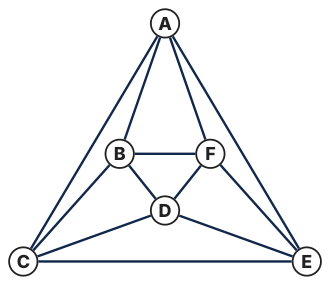
Each vertex has degree 6; 21 edges.
Worked solutions to the practice questions in Chapter 12 of Photon Guidebook: Mathematics Applications and Interpretation HL for the IB Diploma (2026 Edition). Each solution shows every step with the mark it earns, the way an IB mark scheme does.
One idea at a time, in the order the chapter teaches them.
Final answer
Each vertex has degree 6; 21 edges.
Final answer
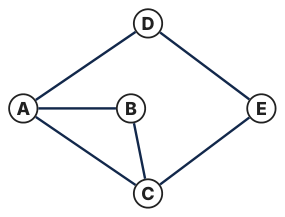
a=b=0. An edge works both ways, so the matrix is symmetric about its diagonal.
Final answer
(a) M^2=\begin{pmatrix}2&1&1\\1&2&1\\1&1&2\end{pmatrix}; 1 walk from A to B. (b) A walk is any sequence of edges, so it may pass through a vertex more than once.
Final answer
The network is connected and every degree is even, so an Eulerian circuit exists.
Final answer
LM, KL, MN, NO; 80 dollars.
Final answer
EC, CA, CB, BD; 578. BD does not touch E, so it cannot be chosen first.
Final answer
Repeat PQ and RS (322, the least pairing); 1649+322=1971 m.
Final answer
C, D, E, B, A, C; 215.
Final answer
Tree BC 62 and CD 68, weight 130, plus AB 56 and AC 71 (127): lower bound 257.
Final answer
327\le L\le335. No: the bounds do not prove that the tour of weight 335 is shortest.
Exam-style questions on each question type, with the marks the IB would give.
Final answer
(a) The degrees would add up to 7\times3=21, which is odd. (b) 36 matches. (c) 20 players. (d) Each edge adds 2 to the sum of the degrees, so the sum is even and the odd degrees come in pairs.

Final answer
(a) Every degree is 4 and the graph is connected. (b) A, B, C, D, E, F, A. (c) Eulerian circuit; Hamiltonian cycle. (d) Yes: A and B become odd, so start at A and finish at B.

Final answer
(a) M=\begin{pmatrix}0&1&1&1&0\\1&0&1&0&0\\1&1&0&0&1\\1&0&0&0&1\\0&0&1&1&0\end{pmatrix}. (b) 11. (c) 2: round triangle ABC in either direction; reversing a route gives another.

Final answer
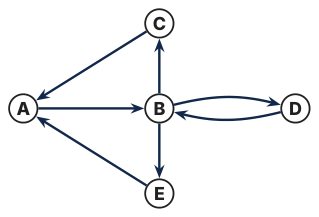
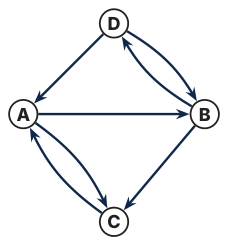
(a) M=\begin{pmatrix}0&1&0&0&0\\0&0&1&1&1\\1&0&0&0&0\\0&1&0&0&0\\1&0&0&0&0\end{pmatrix}. (b) C to D has entry 0 in M+M^2. (c) k=3.

Final answer
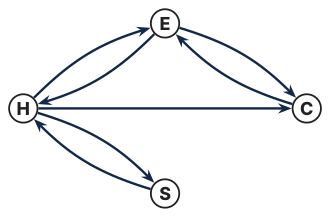
(a) M=\begin{pmatrix}0&\frac12&1&0\\\frac13&0&0&1\\\frac13&0&0&0\\\frac13&\frac12&0&0\end{pmatrix}. (b) \frac12. (c) \frac3{11},\frac4{11},\frac1{11},\frac3{11}: Events is visited most (36.4%). (d) For example, the visitor chooses links at random.


Final answer
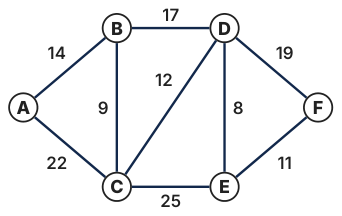
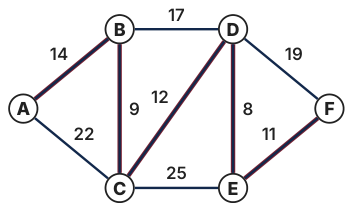
DE, BC, EF, CD, AB; 54 km.

Final answer
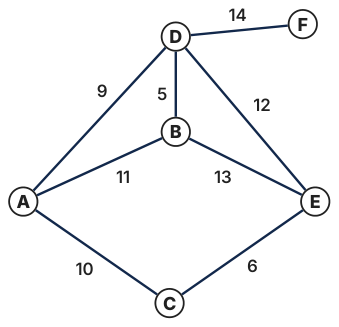
(a) A, B, E, F. (b) AB + EF =37; AE + BF =35; AF + BE =36. (c) 115 km, repeating AC, CE, BD and DF. (F has degree 1, which is still odd.)

Final answer
(a) Start and finish at two odd vertices, so only the other two are repeated. (b) Start at E and finish at F; 91 km. (c) 24 km.
Final answer
(a) The tour cannot be shorter than 214. (b) 230 is allowed but not proved. (c) That tour is optimal. (d) 11.2%. (e) Take the largest lower bound and the smallest upper bound.
Final answer
P to T should be 22 km (P, R, T).
Full exam questions that mix question types, at Paper 1 and Paper 2 standard.
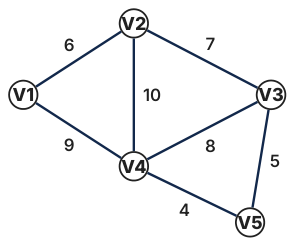
| V_1 | V_2 | V_3 | V_4 | V_5 | |
| V_1 | – | 6 | – | 9 | – |
| V_2 | 6 | – | 7 | 10 | – |
| V_3 | – | 7 | – | 8 | 5 |
| V_4 | 9 | 10 | 8 | – | 4 |
| V_5 | – | – | 5 | 4 | – |

Final answer
V1V2, V2V3, V3V5, V5V4; 22 m; 4 edges, because a tree on 5 vertices has 5-1 edges.

Final answer
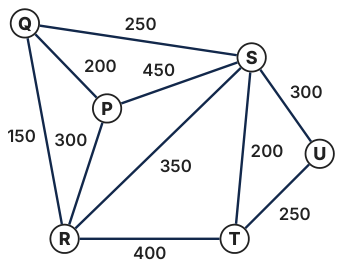
(a) 2850 m. (b) P 3, Q 3, R 4, S 5, T 3, U 2; odd: P, Q, S, T. (c) PQ + ST =400; PS + QT =900; PT + QS =900. (d) 3250 m.

Final answer
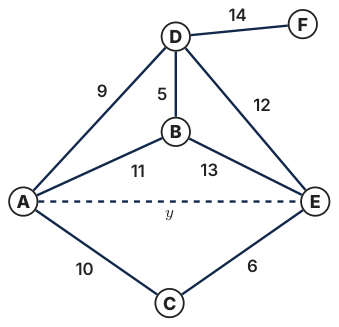
(a) B and F. (b) 99+y km. (c) 0<y<16. (d) 4 km.
Final answer
(a) M=\begin{pmatrix}0&1&1&1\\1&0&0&0\\1&0&0&0\\1&0&0&0\end{pmatrix}. (b) Shown. (c) M^{2n+1}=3^nM. (d) 81. (e) 3^n.

Final answer
(a) M=\begin{pmatrix}0&1&1&0\\0&0&1&1\\1&0&0&0\\1&1&0&0\end{pmatrix}. (b) 2. (c) 4. (d) M=\begin{pmatrix}0&0&1&\frac12\\\frac12&0&0&\frac12\\\frac12&\frac12&0&0\\0&\frac12&0&0\end{pmatrix}. (e) \frac3{16}. (f) \frac6{17},\frac4{17},\frac5{17},\frac2{17}: A is busiest. (g) The stations have different numbers of outgoing links, so the paths are not equally likely.
| D | K | L | M | N | P | |
| D | – | – | 32 | 36 | 26 | 39 |
| K | – | – | 42 | 40 | 29 | 47 |
| L | 32 | 42 | – | 9 | 13 | – |
| M | 36 | 40 | 9 | – | 11 | 8 |
| N | 26 | 29 | 13 | 11 | – | – |
| P | 39 | 47 | – | 8 | – | – |
Final answer
(a) 55, 17, 19. (b) D, N, M, P, L, K, D; 159 km. (c) 115 km. (d) M has degree 3. (e) 123\le L\le152. (f) EUR 135.69 to EUR 157.37. (g) 151 km, inside the interval and shorter than 159 km.
Beyond the syllabus: the worked examples and investigations of the chapter's Going further pages.
Final answer
QR, ST, PR, QT with length 33; L\le66; 33<L\le66 is wider than 47\le L\le54.
Final answer
Shown; HA and AB are shorter than HB, so Kruskal rejects HB.
Final answer
\sqrt{18}, 6.08; 23.5; 47.0; 32.9; 31.7; 31.7\le L\le32.9, within about 4%; explained.
From the book
Photon Guidebook: Mathematics Applications and Interpretation HL for the IB Diploma
Chapter 12 teaches graph theory from the basics to full exam questions: how the IB asks it, every question type with a marked example, and these practice questions in three steps.
Questions © 2026 Photon Academy IB Tuition. Original IB-style questions; not IB past-paper questions. This site is independent and not endorsed by the IB.