Free worked solutions · 2026 Edition

IB Maths AI HL Chapter 1: Number, approximation and error worked solutions

Worked solutions to the practice questions in Chapter 1 of Photon Guidebook: Mathematics Applications and Interpretation HL for the IB Diploma (2026 Edition). Each solution shows every step with the mark it earns, the way an IB mark scheme does.

  • Chapter 1 of 24
  • Volume 1
  • 26 practice questions
  • 1 Going further
  • Free, no sign-up

Basics

One idea at a time, in the order the chapter teaches them.

Question 1

[2 marks]
A habitat database records 5 830 000 leaf scans.
Express this count in standard form.
[2]
Show solutionHide solution
Move the decimal six places to obtain a coefficient between 1 and 10.
M1
5.83\times10^6.
A1

Final answer

5.83\times10^6 scans.

Question 2

[3 marks]
A rectangular micro-label is 6.4\times10^{-3} m long and 3.7\times10^{-4} m wide.
Calculate its area in standard form.
[3]
Show solutionHide solution
Area =(6.4\times10^{-3})(3.7\times10^{-4}).
M1
6.4(3.7)=23.68, giving 23.68\times10^{-7}.
M1
2.368\times10^{-6} square metres.
A1

Final answer

2.368\times10^{-6}\text{ m}^2.

Question 3

[3 marks]
A droplet occupies 7.25\times10^{-9} cubic metres. Use 1 m =1000 mm.
Find its volume in cubic millimetres and explain the power of ten used.
[3]
Show solutionHide solution
Cubic conversion factor is 1000^3=10^9.
R1
7.25\times10^{-9}\times10^9.
M1
7.25 cubic millimetres.
A1

Final answer

7.25\text{ mm}^3; multiply by 10^9.

Question 4

[2 marks]
A survey records a path length of 5867 metres.
Round to three significant figures.
[2]
Show solutionHide solution
5870 m.
A1
The fourth significant digit is 7; increase the tens digit.
R1

Final answer

5870 m.

Question 5

[3 marks]
A length is reported as 32 cm to the nearest centimetre. A halfway value rounds upward.
Write the full interval of possible lengths and explain the open upper endpoint.
[3]
Show solutionHide solution
Half the rounding unit is 0.5 cm.
M1
31.5\le L<32.5 cm.
A1
32.5 would round to 33, so is excluded.
R1

Final answer

31.5\le L<32.5 cm; 32.5 rounds to 33.

Question 6

[3 marks]
A component mass is 470 g to two significant figures. Halfway values round upward.
Find its rounding unit and interval of possible masses.
[3]
Show solutionHide solution
Rounding unit is 10 g.
A1
Half-unit is 5 g.
M1
465\le m<475 g.
A1

Final answer

Unit 10 g; 465\le m<475 g.

Question 7

[4 marks]
A rectangle has measured length 14.6 cm and width 9.2 cm, each to the nearest 0.1 cm. Halfway values round upward.
Find lower and upper bounds for its area.
[4]
Show solutionHide solution
14.55\le L<14.65 and 9.15\le W<9.25.
A1
Multiply the two lower endpoints and the two upper endpoints.
M1
A_{\min}=14.55(9.15)=133.1325 square centimetres.
A1
A<14.65(9.25)=135.5125 square centimetres.
A1

Final answer

133.1325\le A<135.5125\text{ cm}^2.

Question 8

[4 marks]
A resource amount is 52 units to the nearest unit. The time used is 8.4 hours to the nearest 0.1 hour. Halfway values round upward.
Find lower and upper bounds for amount per hour, to three significant figures.
[4]
Show solutionHide solution
51.5\le Q<52.5, 8.35\le t<8.45.
A1
Lower limiting rate 51.5/8.45.
M1
Upper limiting rate 52.5/8.35.
M1
Lower limiting rate \approx6.09; upper limiting rate \approx6.29 units per hour (3 s.f.); both endpoints are excluded.
A1

Final answer

Lower and upper limiting rates 6.09, 6.29 units/h; both excluded.

Question 9

[3 marks]
An exact total is 2180 Singapore dollars and an estimate is 2245 Singapore dollars. A student divides the absolute error by 2245.
Explain the denominator error and find the correct percentage error to three significant figures.
[3]
Show solutionHide solution
Percentage error is measured relative to the exact 2180-dollar total.
R1
100(65/2180).
M1
2.98%.
A1

Final answer

Divide by the exact SGD 2180; 2.98%.

Question 10

[3 marks]
An exact reference value is 148 units. An acceptable estimate must have percentage error at most 2.5%.
Find the complete interval of acceptable estimates.
[3]
Show solutionHide solution
Maximum absolute error =0.025(148)=3.7.
M1
Endpoints 148-3.7 and 148+3.7.
M1
144.3\le E\le151.7.
A1

Final answer

144.3\le E\le151.7 units.

Tutorial

Exam-style questions on each question type, with the marks the IB would give.

Question 11

[6 marks]
Zoe wants to check her GDC answers quickly. She estimates each calculation by rounding every number to 1 significant figure.
(a) Estimate the value of 7.8\times42.3.
[2]
(b) Estimate the value of \dfrac{295}{0.62}.
[2]
(c) Estimate the value of \dfrac{48.7\times0.21}{0.0098}.
[2]
Show solutionHide solution
(a) 8\times40
[1]
=320
[1]
(b) \dfrac{300}{0.6}
[1]
=500
[1]
(c) \dfrac{50\times0.2}{0.01}
[1]
=1000
[1]

Final answer

  • (a) 320
  • (b) 500
  • (c) 1000.

Question 12

[7 marks]
A messaging app is used by 2.84\times10^{6} people in Asia and 9.6\times10^{5} people in Europe.
(a) Find the total number of users in the two regions. Give your answer in standard form, correct to 3 significant figures.
[2]
(b) Find the percentage of all users who are in Europe, correct to 3 significant figures.
[2]
(c) Next year the number of users in Asia is expected to grow by 15% and the number in Europe by 40%. Find the expected total number of users next year, in standard form to 3 significant figures.
[3]
Show solutionHide solution
(a) 2.84\times10^{6}+0.96\times10^{6}
[1]
=3.80\times10^{6}
[1]
(b) \dfrac{9.6\times10^{5}}{3.8\times10^{6}}\times100
[1]
=25.3\%
[1]
(c) Asia: 2.84\times10^{6}\times1.15=3.266\times10^{6}
[1]
Europe: 9.6\times10^{5}\times1.40=1.344\times10^{6}
[1]
Total =4.61\times10^{6}
[1]

Final answer

  • (a) 3.80\times10^6
  • (b) 25.3%
  • (c) 4.61\times10^6 users.

Question 13

[7 marks]
A rectangular bedroom floor is measured as 4.2 m by 3.6 m. Each measurement is accurate to 2 significant figures.
(a) Write down the error interval for each of the two measurements.
[2]
(b) Find the lower and upper bounds of the area of the floor.
[3]
(c) Carpet is sold only in whole numbers of square metres. Nia buys 15 m^2. Explain why this might not be enough, and find the smallest whole number of square metres that is certain to be enough.
[2]
Show solutionHide solution
(a) 4.15\le L<4.25 m
[1]
3.55\le W<3.65 m
[1]
(b) Lower bound: 4.15\times3.55=14.7325
[2]
Upper bound: 4.25\times3.65=15.5125
[1]
So 14.7325\le A<15.5125 m^2.
(c) The upper bound 15.5125>15, so the true area could exceed 15 m^2.
[1]
16 m^2
[1]

Final answer

(a) 4.15\le L<4.25, 3.55\le W<3.65 m. (b) 14.7325\le A<15.5125\text{ m}^2. (c) 16\text{ m}^2; 15 may fail.

Question 14

[7 marks]
Alyssa works shifts at a café. Her payslip shows earnings of SGD 1260, correct to the nearest SGD 10, for 84 hours worked, correct to the nearest hour. Her hourly rate of pay is r=\dfrac{\text{earnings}}{\text{hours}}.
(a) Write down the error intervals for the earnings E and the hours H.
[2]
(b) Find the lower and upper bounds of r, correct to 3 significant figures.
[3]
(c) Her contract promises at least SGD 14.50 per hour, and a staff campaign asks for SGD 15.00 per hour. State, with a reason for each, whether Alyssa can be certain that she was paid at least (i) SGD 14.50 per hour, (ii) SGD 15.00 per hour.
[2]
Show solutionHide solution
(a) 1255\le E<1265 (SGD )
[1]
83.5\le H<84.5 hours
[1]
(b) Smallest rate: least earnings over greatest hours, \dfrac{1255}{84.5}=14.852\ldots
[2]
Largest rate: \dfrac{1265}{83.5}=15.149\ldots
[1]
The lower and upper limiting rates are 14.9 and 15.1 SGD per hour (3 s.f.); retain the unrounded limits for decisions.
(c) (i) 14.85>14.50, so she is certain to have been paid at least SGD 14.50 per hour.
[1]
(ii) 14.85<15.00, so she cannot be certain: her true rate could be below SGD 15.00 per hour.
[1]

Final answer

  • (a) 1255\le E<1265 SGD; 83.5\le H<84.5 h. (b) Limiting rates 14.9, 15.1 SGD/h (3 s.f.). (c) (i) Certain
  • (ii) not certain: the unrounded lower limit is 14.852\ldots.

Question 15

[5 marks]
A bag of rice is labelled 500 g. A shopper uses the label as the mass of the rice. Its true mass, found with a laboratory balance, is 487 g.
(a) Find the absolute error in using the label as the mass.
[1]
(b) Find the percentage error, correct to 3 significant figures.
[2]
(c) A student calculates \dfrac{13}{500}\times100=2.6\%. Explain the mistake.
[2]
Show solutionHide solution
(a) |500-487|=13 g
[1]
(b) \dfrac{|500-487|}{487}\times100
[1]
=2.67\%
[1]
(c) The percentage error must be taken relative to the exact (true) value, 487 g, which belongs in the denominator.
[1]
The student divided by the approximate value, the label.
[1]

Final answer

  • (a) 13 g
  • (b) 2.67%
  • (c) use 487, the true mass, as divisor.

Question 16

[6 marks]
A streaming platform announces that a video had approximately 1 250 000 views. An audit shows that the percentage error in this announced figure is 12%.
(a) Let v be the true number of views. Write down an equation involving v and the modulus sign that expresses the percentage error.
[2]
(b) Find the two possible values of v, to the nearest whole number.
[3]
(c) Explain why the two possible values are not the same distance from 1 250 000.
[1]
Show solutionHide solution
(a) \dfrac{|1\,250\,000-v|}{v}\times100=12
[1]
(exact value v in the denominator)
[1]
(b) Case 1, announced figure too high: 1\,250\,000-v=0.12v
[1]
v=\dfrac{1\,250\,000}{1.12}=1\,116\,071
[1]
Case 2, announced figure too low: v-1\,250\,000=0.12v, so v=\dfrac{1\,250\,000}{0.88}=1\,420\,455
[1]
(c) The 12% is taken of the true value, which is different in the two cases (about 134 000 below versus 170 000 above).
[1]

Final answer

(a) 100|1\,250\,000-v|/v=12. (b) 1 116 071, 1 420 455 views. (c) The divisor changes.

Question 17

[9 marks]
A tile manufacturer measures the side of a square tile as 7.8 cm, correct to 1 decimal place. He computes the area of the tile as 7.8^{2}=60.84 cm^2 and prints it on the box.
(a) Write down the error interval for the true side length s of the tile.
[1]
(b) Find the lower and upper bounds of the true area of the tile.
[2]
(c) Find the largest possible percentage error in the printed value 60.84, correct to 3 significant figures. Justify which end of the interval gives it.
[4]
(d) The absolute error is larger at the upper bound (0.7825 against 0.7775). Explain why the percentage error is nevertheless larger at the lower bound.
[2]
Show solutionHide solution
(a) 7.75\le s<7.85 cm
[1]
(b) 7.75^2=60.0625 and 7.85^2=61.6225
[1]
60.0625\le A<61.6225 cm^2
[1]
(c) At the lower bound: \dfrac{|60.84-60.0625|}{60.0625}\times100=1.29\%
[2]
At the upper bound: \dfrac{|60.84-61.6225|}{61.6225}\times100=1.27\%
[1]
The larger value is 1.29%, at the lower bound.
[1]
(d) The percentage error divides by the true (exact) value.
[1]
At the lower bound the true area is smaller, so the division gives a larger percentage even though the absolute error is slightly smaller.
[1]

Final answer

(a) 7.75\le s<7.85 cm. (b) 60.0625\le A<61.6225\text{ cm}^2. (c) 1.29%, lower end. (d) The smaller divisor outweighs the smaller absolute error.

Question 18

[7 marks]
A manufacturer makes metal spheres. The radius of one sphere is measured as r=6.5 cm, correct to 1 decimal place. The volume of a sphere is V=\tfrac43\pi r^{3}.
(a) Calculate the volume using r=6.5 cm, correct to 3 significant figures.
[1]
(b) Find the lower and upper bounds of the volume, correct to the nearest cm^3.
[3]
(c) The value from part (a) is quoted as the volume. Find the largest possible percentage error, correct to 3 significant figures, and state which bound gives it.
[3]
Show solutionHide solution
(a) \tfrac43\pi(6.5)^3=1150.3\ldots\approx1150 cm^3
[1]
(b) 6.45\le r<6.55
[1]
Lower: \tfrac43\pi(6.45)^3=1124.0\ldots
[1]
Upper: \tfrac43\pi(6.55)^3=1177.1\ldots, so 1124\le V<1177 cm^3
[1]
(c) At the lower bound: \dfrac{1150.35-1124.00}{1124.00}\times100=2.34\%
[2]
At the upper bound: \dfrac{1177.10-1150.35}{1177.10}\times100=2.27\%, so the largest is 2.34% at the lower bound.
[1]

Final answer

(a) 1150\text{ cm}^3. (b) Limiting volumes 1124, 1177\text{ cm}^3 (nearest \text{cm}^3). (c) 2.34% at the lower bound, retaining the calculation from (a).

Question 19

[7 marks]
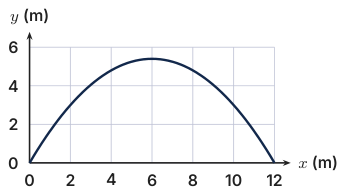
The arched roof of a drainage tunnel has cross-section y=0.15x(12-x) for 0\le x\le12, where x and y are measured in metres. The graph is shown. A surveyor estimates the area under the arch using the trapezoidal rule with 6 intervals of equal width.
Original Photon diagram
(a) Copy and complete the table of values of y.
\begin{array}{c|ccccccc} x & \text{0} & \text{2} & \text{4} & \text{6} & \text{8} & \text{10} & \text{12} \\ \hline y & \text{0} & & & & & & \text{0} \\ \end{array}
[2]
(b) Use the trapezoidal rule to estimate the area under the arch.
[2]
(c) Use your GDC to find the exact area \displaystyle\int_0^{12}0.15x(12-x)\,dx.
[1]
(d) Find the percentage error in the surveyor's estimate, correct to 3 significant figures.
[2]
Show solutionHide solution
(a) y: 0,\ 3,\ 4.8,\ 5.4,\ 4.8,\ 3,\ 0
[2]
(b) \dfrac12(2)\bigl[(0+0)+2(3+4.8+5.4+4.8+3)\bigr]
[1]
=42.0 m^2
[1]
(c) 43.2 m^2
[1]
(d) \dfrac{|42.0-43.2|}{43.2}\times100
[1]
=2.78\%
[1]

Final answer

(a) 0,3,4.8,5.4,4.8,3,0 m. (b) 42.0\text{ m}^2. (c) 43.2\text{ m}^2. (d) 2.78%.

Question 20

[7 marks]
Hui Min wants to slide a bookshelf into an alcove. The alcove is 83.1 cm wide and the shelf is 82.4 cm wide, each measured correct to the nearest millimetre.
(a) Write down the error interval for the width of the alcove and for the width of the shelf.
[2]
(b) Find the greatest and the least possible gap w-s between the alcove and the shelf.
[3]
(c) The shelf needs a gap of at least 0.5 cm to slide in. Hui Min says, “It will certainly fit.” Is she correct? Justify your answer.
[2]
Show solutionHide solution
(a) Alcove: 83.05\le w<83.15 cm
[1]
Shelf: 82.35\le s<82.45 cm
[1]
(b) Greatest gap uses the largest alcove and the smallest shelf: 83.15-82.35
[1]
=0.80 cm
[1]
Least gap: 83.05-82.45=0.60 cm
[1]
(c) The least possible gap is 0.60 cm, which is greater than 0.5 cm.
[1]
So she is correct: the shelf is certain to fit.
[1]

Final answer

(a) 83.05\le w<83.15, 82.35\le s<82.45 cm. (b) Gap limits 0.60, 0.80 cm. (c) Certain: even the lower limit exceeds 0.5 cm.

Mastery

Full exam questions that mix question types, at Paper 1 and Paper 2 standard.

Question 21

[8 marks]
A city council reports its annual population as 148 000, correct to the nearest thousand. The reported land area of the city is 62\text{ km}^{2}, correct to the nearest \text{km}^{2}. The population density is D=\dfrac{\text{population}}{\text{area}}, in people per \text{km}^{2}.
(a) Write down the lower and upper bounds of
(i) the population;
[1]
(ii) the land area.
[1]
(b) Find the lower bound of the population density, correct to 3 significant figures.
[3]
(c) Find the upper bound of the population density, correct to 3 significant figures.
[3]
Show solutionHide solution
(a) (i) 147\,500\le P<148\,500
[1]
(ii) 61.5\le A<62.5\text{ km}^{2}
[1]
(b) Least density uses least population and greatest area: D_{\min}=\dfrac{147\,500}{62.5}=2360\text{ people km}^{-2} (3 s.f.)
[3]
(c) Greatest density uses greatest population and least area: D_{\max}=\dfrac{148\,500}{61.5}=2410\text{ people km}^{-2} (3 s.f.)
[3]

Final answer

  • (a) 147\,500\le P<148\,500; 61.5\le A<62.5\text{ km}^2. (b) 2360
  • (c) 2410 people/\text{km}^2.

Question 22

[11 marks]
A designer models a decorative pyramid-shaped ornament as a cuboid box for shipping. The box is measured as length 5.2 cm, width 3.8 cm and height 2.1 cm, each correct to one decimal place.
(a) Write down the lower and upper bounds of the height.
[2]
(b) Calculate the lower bound of the volume of the box.
[3]
(c) Calculate the upper bound of the volume of the box.
[3]
(d) The nominal (rounded) volume is V=5.2\times 3.8\times 2.1. Find the percentage error if the true volume is actually equal to the upper bound found in part (c). Give your answer correct to 3 significant figures.
[3]
Show solutionHide solution
(a) 2.05\le h<2.15 cm
[2]
(b) Lower bounds throughout: V_{\min}=5.15\times 3.75\times 2.05=39.6\text{ cm}^{3} (3 s.f.)
[3]
(c) Upper bounds throughout: V_{\max}=5.25\times 3.85\times 2.15=43.5\text{ cm}^{3} (3 s.f.)
[3]
(d) Nominal V=5.2\times 3.8\times 2.1=41.496\text{ cm}^{3}; true =43.4569\text{ cm}^{3}. \varepsilon=\dfrac{|41.496-43.4569|}{43.4569}\times 100\approx 4.51\%
[3]

Final answer

  • (a) 2.05\le h<2.15 cm. (b) 39.6
  • (c) 43.5\text{ cm}^3. (d) 4.51%.

Question 23

[9 marks]
A scientist compares two approximations of a physical constant whose accepted value is c=299\,792\,458\text{ m s}^{-1}.
Method A gives 3.00\times 10^{8}\text{ m s}^{-1} and Method B gives 2.998\times 10^{8}\text{ m s}^{-1}.
(a) Write c correct to 4 significant figures, in the form a\times 10^{k} with 1\le a<10.
[2]
(b) Find the percentage error of
(i) Method A;
[2]
(ii) Method B.
[2]
(c) State, with a reason, which method is more accurate.
[1]
(d) A third student rounds c to just 1 significant figure. Write down this value and explain why such an approximation would rarely be useful in scientific work.
[2]
Show solutionHide solution
(a) c=2.998\times 10^{8}\text{ m s}^{-1} (4 s.f.)
[2]
(b) (i) Method A: \dfrac{|3.00\times 10^{8}-299\,792\,458|}{299\,792\,458}\times 100\approx 0.0692\%
[2]
(ii) Method B: \dfrac{|2.998\times 10^{8}-299\,792\,458|}{299\,792\,458}\times 100\approx 0.00252\%
[2]
(c) Method B is more accurate because its percentage error is much smaller.
[1]
(d) To 1 s.f., c\approx 3\times 10^{8}\text{ m s}^{-1}. This discards too much information (a spread of tens of millions of m s^{-1}), so it is too imprecise for most scientific calculations.
[2]

Final answer

(a) 2.998\times10^8\text{ m s}^{-1}. (b) 0.0692%, 0.00252%. (c) B, smaller error. (d) 3\times10^8\text{ m s}^{-1}; too coarse for precise work.

Question 24

[12 marks]
A cafe fills cylindrical takeaway cups with coffee. Each cup has internal radius 3.6 cm and is filled to a height of 9.5 cm, both measured correct to one decimal place. The barista uses \pi\approx 3.14 for a quick estimate of the volume.
(a) Using \pi\approx 3.14 and the measured values, estimate the volume of coffee in one cup, in \text{cm}^{3}, correct to 4 significant figures.
[3]
(b) Find the volume using the value of \pi from a calculator, again with the measured values, correct to 4 significant figures.
[2]
(c) Find the percentage error introduced by using \pi\approx 3.14 instead of the calculator value, correct to 3 significant figures.
[2]
(d) Using the calculator value of \pi, and taking the radius and height at their upper bounds, find the upper bound of the volume, correct to 4 significant figures.
[3]
(e) One litre is 1000\text{ cm}^{3}. Determine the greatest number of these cups that can be completely filled from a 2 litre flask of coffee, using the upper-bound volume from part (d).
[2]
Show solutionHide solution
(a) V\approx 3.14\times 3.6^{2}\times 9.5=3.14\times 12.96\times 9.5=386.6\text{ cm}^{3} (4 s.f.)
[3]
(b) V=\pi\times 3.6^{2}\times 9.5=386.8\text{ cm}^{3} (4 s.f.)
[2]
(c) \varepsilon=\dfrac{|386.597-386.793|}{386.793}\times 100\approx 0.0507\%
[2]
(d) Upper bounds: r=3.65, h=9.55. V_{\max}=\pi\times 3.65^{2}\times 9.55=399.7\text{ cm}^{3} (4 s.f.)
[3]
(e) 2 litres =2000\text{ cm}^{3}. \dfrac{2000}{399.7}\approx 5.004, so at most 5 full cups.
[2]

Final answer

  • (a) 386.6
  • (b) 386.8\text{ cm}^3. (c) 0.0507%. (d) 399.7\text{ cm}^3. (e) 5 cups.

Question 25

[15 marks]
A river authority monitors the concentration C (mg per litre) of a pollutant for 12 hours after a spill. The concentration is modelled by C(t)=0.5+1.6t-0.1t^{2} for 0\le t\le12, where t is in hours. The total exposure is the area under the graph of C against t. A health limit for total exposure over the 12 hours is 63 mg h per litre.
(a) Calculate C at t=0,2,4,6,8,10,12.
[2]
(b) Use the trapezoidal rule with 6 intervals to estimate the total exposure.
[3]
(c) Use your GDC to find the exact total exposure, and hence the percentage error in your estimate, correct to 3 significant figures.
[3]
(d) State whether the trapezoidal rule over-estimates or under-estimates the exposure here, and give a reason based on the shape of the graph.
[1]
(e) Suppose instead that the seven values of C were field readings, each correct to 1 decimal place, so that each has a maximum error of 0.05. Find the greatest and least possible values of the trapezoidal estimate 62.8 if each of the seven readings could be out by 0.05 in either direction.
[3]
(f) The authority's analyst says, “The estimate is below the limit of 63, so the limit was not exceeded.” Use your answers to explain why this conclusion is unsafe.
[3]
Show solutionHide solution
(a) 0.5,\ 3.3,\ 5.3,\ 6.5,\ 6.9,\ 6.5,\ 5.3
[2]
(b) \dfrac12(2)\bigl[(0.5+5.3)+2(3.3+5.3+6.5+6.9+6.5)\bigr]
[2]
=62.8 mg h per litre
[1]
(c) Exact =\displaystyle\int_0^{12}(0.5+1.6t-0.1t^2)\,dt=63.6
[1]
\dfrac{|62.8-63.6|}{63.6}\times100
[1]
=1.26\%
[1]
(d) Under-estimate: the graph is concave down (it bends below the tangent), so each chord lies below the curve.
[1]
(e) The readings have total weight 1+1+2(5)=12 in the bracket, then multiplied by \tfrac12h=1.
[1]
The estimate can change by up to 12\times0.05=0.6.
[1]
So the estimate lies between 62.2 and 63.4 mg h per litre.
[1]
(f) The exact exposure is 63.6>63, so the limit was exceeded.
[1]
The trapezoidal rule under-estimates for a concave graph, so an estimate below the limit does not prove the true value is below it.
[1]
Even allowing for the rounding errors, the upper value 63.4 is above the limit.
[1]

Final answer

  • (a) 0.5,3.3,5.3,6.5,6.9,6.5,5.3 mg/L. (b) 62.8
  • (c) 63.6 mg h/L, 1.26%. (d) Underestimate: chords lie below the curve. (e) 62.2 to 63.4 mg h/L. (f) Unsafe: both 63.6 and the upper estimate exceed 63.

Question 26

[16 marks]
The plan of a field is bounded by a straight road and a curved stream. Kaveh measures the distance from the road to the stream every 20 m along the 120 m length of road.
\begin{array}{c|rrrrrrr}\text{Distance (m)}&0&20&40&60&80&100&120\\\hline\text{Width (m)}&34&41&45&46&43&37&28\end{array}
(a) Use the trapezoidal rule to estimate the area of the field.
[3]
A drone survey gives the area as 4932\text{ m}^2.
(b) Taking this value as exact, find the percentage error in your estimate.
[2]
Each width was measured correct to the nearest metre.
(c) Find the lower and upper bounds of the trapezoidal estimate.
[3]
(d) Determine whether rounding the widths alone can explain the difference between the drone area and your estimate.
[2]
Seed is sown at 35 g per \text{m}^2 and sold in 2.5 kg bags.
(e) Using the drone area, find the number of bags Kaveh needs.
[3]
The drone area is correct to the nearest 10\text{ m}^2 and the sowing rate to the nearest 5 g per \text{m}^2.
(f) Determine whether the number of bags in (e) is certain to be enough.
[3]
Show solutionHide solution
(a) h=20 m (A1). T=10[(34+28)+2(41+45+46+43+37)]=4860\text{ m}^2 (M1 A1).
(b) 100|4860-4932|/4932=1.46\% (M1 A1).
(c) Changing every width by 0.5 m changes T by 10[(0.5+0.5)+2(5\times0.5)]=60\text{ m}^2 (M1 A1). Hence 4800\le T<4920\text{ m}^2 (A1).
(d) 4932>4920 (M1), so rounding alone cannot explain the discrepancy (R1). The straight strips also approximate the stream boundary.
(e) 4932\times35=172\,620 g (M1), or 172.62/2.5=69.048 bags (M1). Buy 70 bags (A1).
(f) The upper limiting mass is 4935\times37.5=185\,062.5 g (M1 A1), requiring up to 75 bags, whereas 70 hold 175 kg. The original order is not certain to suffice (R1).

Final answer

(a) 4860\text{ m}^2. (b) 1.46%. (c) 4800\le T<4920\text{ m}^2. (d) No: 4932>4920. (e) 70 bags. (f) Not certain: up to 75 may be needed.

Going further

Beyond the syllabus: the worked examples and investigations of the chapter's Going further pages.

G1 Investigation

[17 marks]
Nia measures a ball bearing's diameter as d=12.0 mm, correct to 1 decimal place. Its volume is V=\pi d^3/6.
(a) Give the diameter bounds, then find the limiting volumes to 1 decimal place in \text{mm}^3.
[3]
(b) Using the unrounded volume from d=12.0 as the quoted volume, find its largest percentage error. Express the diameter half-unit as a percentage of 12.0 mm and compare three times this percentage with your volume error.
[4]
(c) Expand (1+z)^3 and explain why it is approximately 1+3z for small z. Connect this with your comparison in (b).
[2]
For Nia's model y=4-x^2 on 0\le x\le2, coordinates are in metres and the exact area is 16/3\text{ m}^2.
(d) Find the trapezoidal estimates using two and four equal strips, and each percentage error. The percentage error with n strips is 25/n^2\%; verify this for eight strips by calculating the estimate.
[5]
(e) Find the least strip count giving percentage error below 0.1\%. Explain geometrically why every trapezoidal estimate for this model is too small.
[3]
Show solutionHide solution
(a) Half-unit 0.05 mm gives 11.95\le d<12.05 mm (A1). Since volume increases with positive diameter, V_L=\pi(11.95)^3/6=893.5\text{ mm}^3 and V_U=\pi(12.05)^3/6=916.1\text{ mm}^3 to 1 d.p. (M1 A1). These displayed endpoints are rounded limiting values.
(b) Retain V_0=\pi(12)^3/6. At the lower bound, 100(V_0-V_L)/V_L=1.26\%; at the upper, 100(V_U-V_0)/V_U=1.24\%. The largest is 1.26\% at the lower end (M1 A1). The half-unit percentage relative to the quoted diameter is 100(0.05)/12=0.417\% (M1). Three times this is 1.25\%, close to the volume error (R1).
(c) (1+z)^3=1+3z+3z^2+z^3 (A1). When |z| is small, the squared and cubed terms are small compared with the linear term, so the volume's leading fractional change is three times the diameter's (R1).
(d) With h=1, T_2=\tfrac12[4+0+2(3)]=5\text{ m}^2. With h=0.5, T_4=\tfrac14[4+0+2(3.75+3+1.75)]=5.25\text{ m}^2 (M1 A1). Comparing each with 16/3 gives 6.25\% and 1.5625\% (A1). With eight strips, h=0.25 and the interior ordinates are 3.9375,3.75,3.4375,3,2.4375,1.75,0.9375. Hence T_8=5.3125\text{ m}^2 (M1). The percentage error is 0.390625\%=25/8^2\%, verifying the rule (A1).
(e) 25/n^2<0.1 gives n>\sqrt{250} (M1). Thus the least integer is 16: 25/16^2<0.1, whereas 25/15^2>0.1 (A1). The curve bends downwards, so each chord lies below it and its trapezium omits some area (R1).

Final answer

(a) [11.95,12.05) mm; limiting volumes 893.5 and 916.1 mm^3. (b) 1.26%; 0.417%, tripled 1.25%. (c) 1+3z+3z^2+z^3. (d) 5, 5.25, 5.3125 m^2; 6.25%, 1.5625%, 0.390625%. (e) 16 strips; chords below curve.
From the book

Photon Guidebook: Mathematics Applications and Interpretation HL for the IB Diploma

Chapter 1 teaches number, approximation and error from the basics to full exam questions: how the IB asks it, every question type with a marked example, and these practice questions in three steps.

About the book